Overview
Below is a clear, number-driven guide that shows every major bill you will face, so you can budget with confidence rather than guesswork. The figures on this page come from real platform quotes, licensing tables, and operator surveys. We grouped expenses into seven categories, then contrasted them with two recent case studies so you see how theory translates to real life.
By the time you reach the bottom, you will know the ballpark cost of each line item, which parts of the budget you can negotiate, and how your first-year cash flow will look once the platform goes live.
How Much Does It Cost to Launch a White-Label Casino?
White-label casino launch costs fall into seven buckets: 1) license fees, 2) platform setup, 3) game content and RNG certification, 4) payment processing reserves, 5) marketing and bonuses, 6) compliance and security, 7) ongoing hosting and support. Most startups spend $150 000–$500 000 up front and $25 000–$60 000 monthly after launch.
1. Licensing: The Non-Negotiable Permit
Every white-label casino needs a gaming license. That single document unlocks payment gateways, ad accounts, and player trust.
The licensing process includes several separate costs that operators need to plan for before and after launch:
-
Up-front government application: $15 000–$40 000
-
Due-diligence checks per director: $2 000–$4 000
-
Annual renewal: $10 000–$25 000
-
Compliance audit (year two onward): $8 000–$12 000
The cheapest option is often a Curacao sub-license, but many affiliates refuse to send traffic there. A Maltese or Isle of Man permit costs more yet lifts long-term revenue because conversion rates rise. Industry revenue surged after operators switched to European jurisdictions, shown by 27 % higher average deposits. Some white-label providers bundle a master license. You still undergo fit-and-proper checks, but the paperwork is faster.
Choosing the right jurisdiction shapes the rest of your budget. To better understand the trade-offs between major licensing hubs, hidden setup costs, and compliance requirements, see How to Get an Online Gaming License and Operate Legally. Get this wrong and payments or ad platforms may reject you, sending marketing costs through the roof.
2. Platform Setup: Your Digital Casino Floor
A turnkey platform transforms code into cashiers, lobbies, and leaderboards. Prices hinge on feature depth and traffic limits.
The total platform budget usually includes several separate implementation and customization costs:
-
One-time setup fee: $25 000–$60 000
-
Custom UI design: $5 000–$15 000
-
Mobile app wrappers: $3 000–$8 000 per OS
-
Integration of responsible-gaming tools: $2 500–$6 000
Some providers like Smartbet LLC offer all modules—casino, sportsbook, back office—in a single package, lowering integration hours. If you pick separate vendors, schedule at least three extra weeks for testing. If you’re evaluating platform options or comparing white-label and turnkey solutions, review critical contract details and technical features in Top Online Gambling Platforms to Expand Your iGaming Business.
A small operator pushing 500 concurrent players can start with the baseline tier. If you plan influencer campaigns out of the gate, jump to the mid-tier plan because overage charges stack quickly, sometimes 200 % above the normal rate. At the end of this stage, you will hold a functional site but no games, payments, or data feeds yet. Those parts carry their own fees.
3. Game Content and RNG Certification

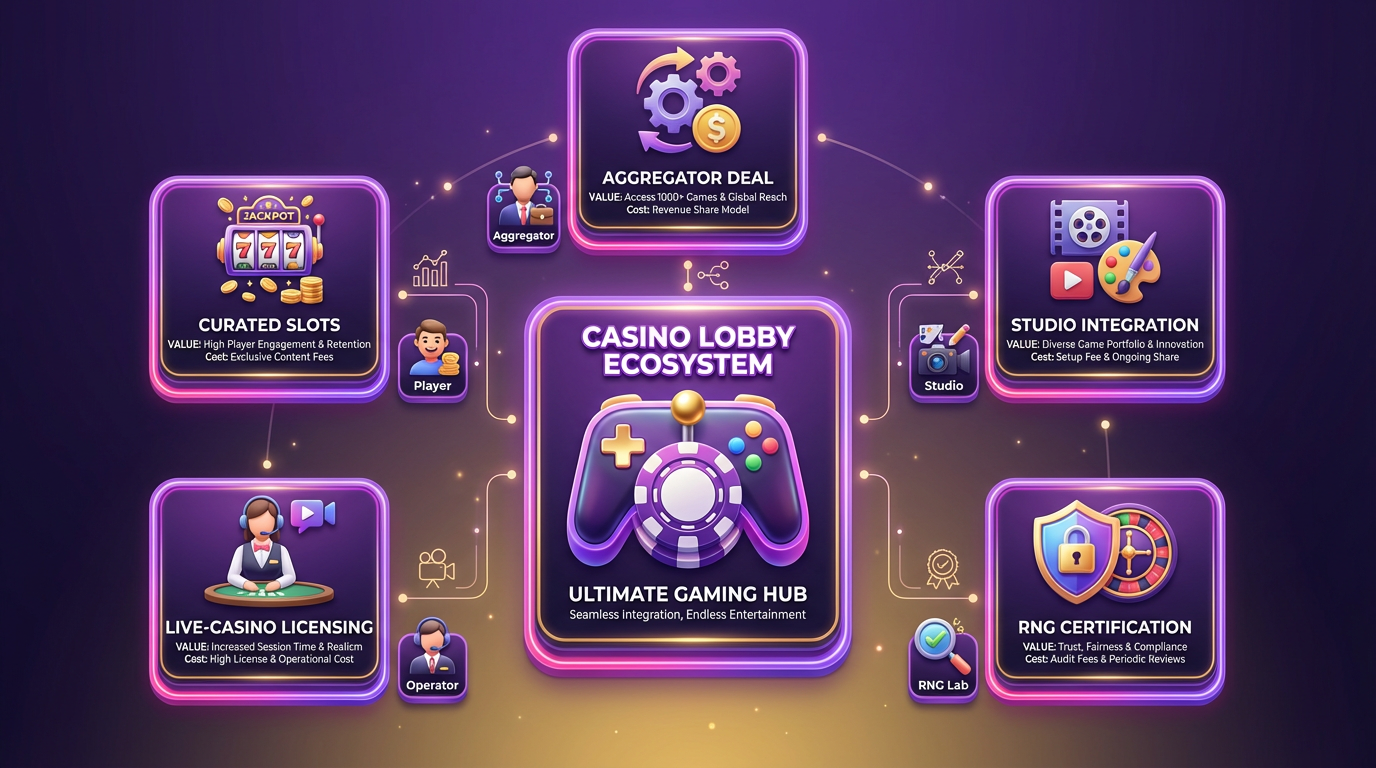
Players will judge you by your lobby depth within seconds. To hit the sweet spot of 1 000–2 000 titles, you need multiple game studios.
Aggregator vs. Direct Deals
Aggregators charge a bundle fee, while direct deals collect per-game royalties.
Operators usually face a mix of upfront integration costs and recurring content fees when they build their game portfolio:
-
Aggregator entrance: $10 000–$20 000
-
Per-studio integration: $3 000–$5 000
-
Monthly minimum guarantee: $2 000–$5 000 per studio
-
RNG lab certification (if unique games): $12 000–$18 000
A popular strategy is to sign two big studios first, then add niche suppliers every quarter. The extra releases create new-game buzz without a steep cash spike. Player data from a Latin American operator showed 35 % longer session times once live-casino streams were added. Expect higher licensing fees, typically $5 000 per table plus revenue share, but engagement pays for it.
Understanding how slot libraries are curated and RNG is certified is critical. For an in-depth guide to content aggregation and fair game certification, see Top Slot Providers Driving the Online Casino Industry. End this step with a lobby that feels alive, varied, and fair, backed by RNG certificates players can read.
4. Payment Processing and Reserve Funds
Even the slickest lobby is useless if players cannot deposit. Banks label gambling as high-risk, so processors demand rolling reserves.
Payment processing costs extend beyond simple gateway access and often include several safeguards against risk and fraud:
-
Gateway setup: $1 000–$3 000 per method
-
Rolling reserve: 5 %–10 % of monthly GGR locked for 180 days
-
Fraud prevention suite: $1 500–$4 000 monthly
-
Chargeback fee: $25–$35 per case
If you operate in card-heavy regions like Canada, the reserve piles up fast. Crypto-friendly gateways are cheaper but still need blockchain monitoring tools. A 2022 report found chargebacks averaging 1.9 % of transactions. Go beyond that threshold and acquirers may shut you down, so put anti-fraud spending in the forecast.
For seamless, multi-currency payment integration and anti-fraud tools, review solutions like Smart Pay to learn more about compliant payment processing and KYC automation. Solid payment rails protect cash flow, allowing marketing to scale without hiccups.
5. Marketing, Bonuses, and Player Acquisition
Hype costs money, yet underfunded promotion leaves casinos empty. Allocate funds across three pillars: bonuses, traffic, and creative assets.
A realistic launch budget should include separate allocations for player acquisition, promotional offers, and creative production:
-
Signup bonus pool: $50 000–$150 000
-
Affiliate commission: 25 %–45 % revenue share
-
PPC and paid social: $10 000–$30 000 per month
-
Brand assets (videos, banners, copy): $4 000–$8 000
A mid-tier European brand spent $80 000 on influencer takeovers during the 2022 World Cup and recorded 190 % revenue growth across its sportsbook-casino crossover. To go deeper on real-world launch marketing, affiliate strategies, and bonus budgeting, see How to Start an Open Online Casino in 2026.
Your first-year LTV will likely sit between $250–$400 per player. Work backward from that number to set CPA caps for affiliates and media buyers. Finish this phase with a calendar of promos that syncs with new game releases for compounding buzz.
6. Compliance, Security, and Data Protection
Regulators expect airtight logs, encryption, and responsible-gaming modules.
To meet these requirements, operators need to budget for several ongoing security, legal, and compliance tools:
-
Independent penetration test: $4 000–$7 000
-
GDPR or equivalent legal counsel: $6 000–$12 000
-
AML and KYC software: $0.80–$1.20 per verification
-
Safe-gambling analytics: $1 500–$3 000 monthly
A data breach easily wipes six figures from profit. In 2023, 14 % of reported breaches hit entertainment and gaming firms. Spend the extra on encryption keys and staff training now rather than legal fees later.
Platforms with robust centralized compliance features can simplify regulatory burdens. Explore integrated approaches provided by Regulation & License. Once these safeguards pass an external audit, you can proceed to soft launch without fear of instant shutdown.
7. Ongoing Hosting, Support, and Platform Fees
Day-to-day costs rarely kill a casino, but they erode margins if ignored.
Once the casino is live, operators still need to cover several recurring expenses to keep the platform stable and competitive:
-
Managed cloud hosting: $2 000–$6 000 monthly
-
24/7 player support: $6 000–$12 000 monthly
-
Platform royalty to provider: 15 %–25 % of GGR
-
Content refresh fees: $1 000–$2 000 for new game batches
If you partner with providers like Smartbet LLC, some of these services come bundled, replacing variable bills with a flat rate. Compare quotes carefully: a higher royalty might include free support agents, which lowers headcount spending.
Lock the final numbers into a rolling forecast so you can see break-even dates and expansion windows.
Case Study: Two Launch Paths, Two Budgets
-
Lean Curacao Startup
-
License package: $18 000
-
Platform + 400 games: $35 000
-
Payment setup: $6 000
-
Marketing kickoff: $60 000
-
Total month-zero spend: $119 000
-
Regulated EU Challenger
-
Maltese license: $45 000
-
Premium platform + sportsbook: $80 000
-
Live casino streams: $30 000
-
Payment and AML stack: $15 000
-
Marketing blitz: $150 000
-
Total month-zero spend: $320 000
Both went live within six months. The EU brand reached ROI in month nine, while the lean startup needed twelve months but enjoyed higher net profit margins due to lower royalty percentages.
Conclusion
Launching a white-label casino is not a mystery expense jar. Map out the seven cost buckets, decide where premium quality beats thrift, and negotiate smartly with platform and content partners. For a template-driven operations roadmap and practical insights on budgeting, see How to Start an Online Casino with Minimal Risk. Accurate budgets let you focus on player experience rather than surprise invoices, giving your brand the best chance to flourish in a competitive yet rewarding market.