Futuristic crypto gambling scene with Bitcoin and Ethereum coins, roulette wheel, slot machine, and live trading dashboards inside a digital casino vault

How to Get an Online Gaming License and Operate Legally

Operating a casino or sportsbook on the internet is a lucrative idea, yet one misstep can shut you down overnight. The quickest way to protect your brand and your players is to secure an online gaming license that meets the rules of a recognized regulator.

Content authorBy Mkrtumyan GagikPublished onReading time9 min read

Overview

In this guide, you will learn exactly how to pick a jurisdiction, prepare your paperwork, and stay compliant long after your site goes live.

The article breaks licensing into six logical stages:

  • Why a license matters and what happens if you ignore it

  • Picking the right regulator for your business goals

  • Meeting core compliance standards for casino legal online operations

  • Completing the application, fees, and technical testing

  • Running audits and reporting once you are live

  • Real-world case studies and tips for scaling safely

By the end, you will know how to transform a concept into a fully licensed gambling site without wasting time or money.

What is an Online Gambling License?

An online gaming license is an official authorization issued by a government regulator that allows a company to legally offer remote betting, casino, or lottery services, subject to strict rules on player protection, anti-money-laundering checks, technical security, and ongoing audits.

Why Licensing Matters: Risk vs Reward

Operating without a license is not a shortcut, it is a direct legal risk. The UK Gambling Commission’s Illegal Markets team issued 3,140 cease-and-desist notices to unlawful operators since April 2024.

This level of enforcement translates into tangible operational and financial risks, including:

  • Unlicensed sites face domain seizures, payment blocking, and criminal charges

  • Players have no recourse if balances disappear

  • Advertising platforms ban unlicensed brands, cutting growth channels

  • Investors and payment providers avoid businesses that lack transparent compliance

Securing an online gaming license is therefore less about red tape and more about survival and long-term profitability. For insight into why the right license is your first line of defense, see How to Choose the Best Casino Websites for Your Gaming Experience.

Choosing the Right Jurisdiction for Licensed Gambling Sites

Different regulators set different rules, costs, and timelines. Start by matching your target markets, risk tolerance, and budget to the jurisdiction’s reputation.

Snapshot of Popular Licensing Hubs

  • Malta Gaming Authority (MGA)

    • EU credibility, robust player protection, corporate tax rate 35 % with refunds

    • Costs: €10,000 application, €25,000+ annual fees

    • Timeline: 3–6 months

  • UK Gambling Commission (UKGC)

    • High trust, access to British market worth £6.5 billion GGY in 2022-2023

    • Strict social responsibility rules, significant reporting load

    • Costs: scaled by revenue, from £4,000 up to £700,000

  • Isle of Man

    • Zero gaming duty on non-resident players, quick favorable tax regime

    • Recognized by many banks and PSPs

    • Typical time: 10–12 weeks

  • Curaçao

    • Lower cost master-sub-license model, revision pending 2025 legislation

    • Good for startups testing multiple markets

  • Kahnawake (Canada)

    • Competitive fees, 0 % gaming tax

    • Growing appeal for North American traffic

For more on matching your market ambitions to license type, turn to Choosing the Right Online Casino Platform for Your Business.

How to Narrow Your Choice

Before committing to a jurisdiction, take a structured approach to your evaluation. A license should support your commercial strategy, not restrict it. The right choice balances market access, tax efficiency, processing speed, and operational flexibility while positioning your business for long-term compliance.

To narrow your options effectively, focus on the following steps:

  • Map out your primary customer countries.

  • Check whether they recognize licenses from each candidate jurisdiction.

  • Compare total fiscal load: application, annual, and gaming duty.

  • Review processing time versus your launch roadmap.

  • Evaluate reporting demands and hardware location rules.

Choosing wisely makes later compliance simpler and reduces the risk of being blacklisted by payment providers.

Meeting Core Compliance Standards for Casino Legal Online Operations

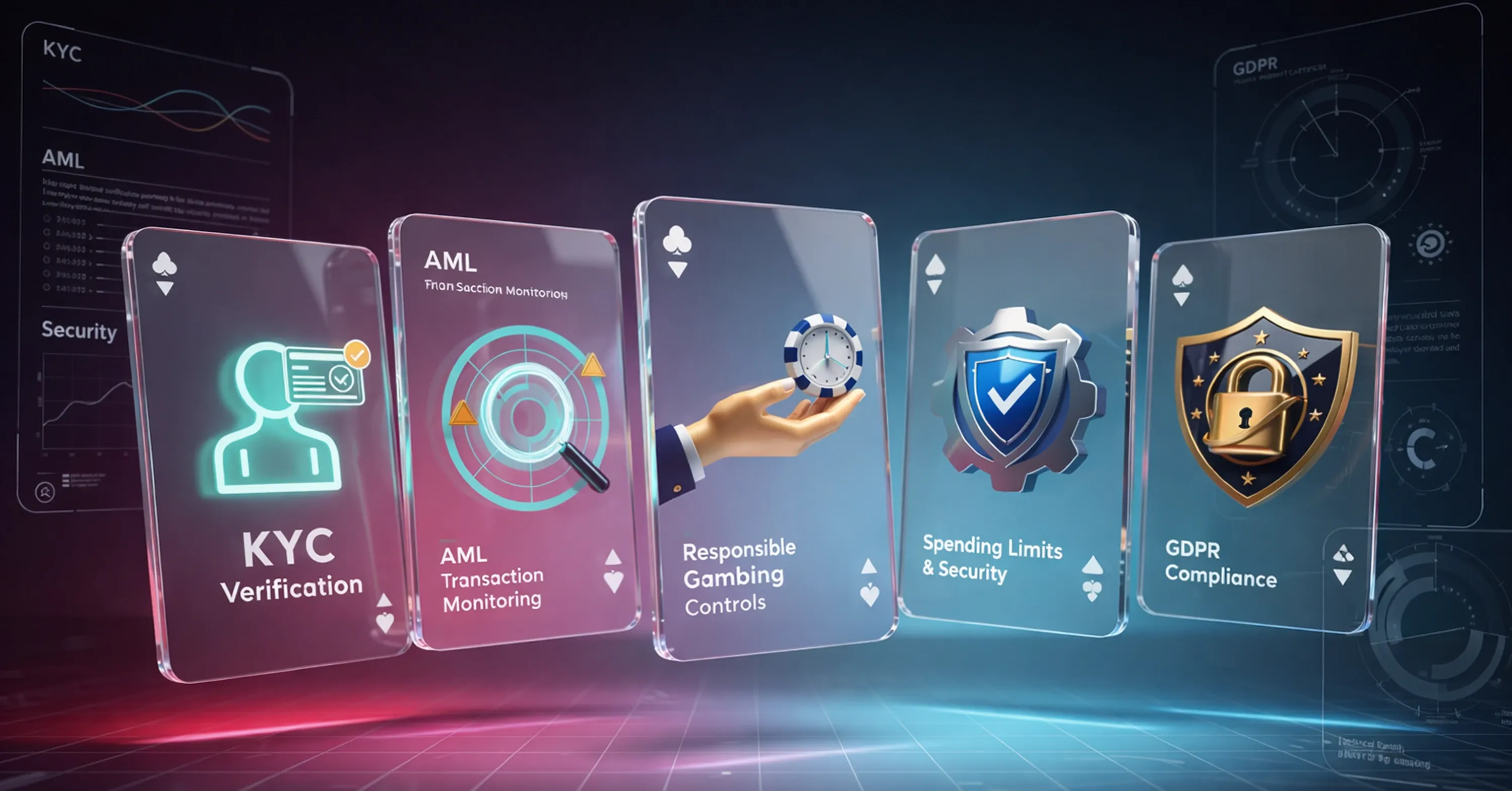
Illustration of KYC verification, AML transaction monitoring, responsible gambling controls, spending limits, and GDPR compliance for online gambling platforms

Even the most regulator-friendly country will expect proof that you can run a safe and fair platform. Below are the common pillars.

  • Player Due Diligence

Operators must implement robust KYC procedures to verify age and identity, alongside enhanced due diligence for high-risk or high-value customers.

  • Anti-Money-Laundering (AML)

Compliance requires transaction monitoring tools and suspicious activity reporting within 24 hours of detection.

  • Responsible Gambling

Licensed platforms must provide deposit, loss, and session limits, as well as self-exclusion systems synchronized with national registers.

  • Technical Security

Systems must undergo RNG certification by accredited laboratories and regular penetration testing across network, database, and payment infrastructure.

  • Data Protection

Operators serving EU players must maintain GDPR compliance, secure hosting environments, and strong encryption for sensitive data.

To stay ahead of requirements and avoid common pitfalls, review the best practices outlined in Top Slot Providers Driving the Online Casino Industry, which covers responsible gambling tools, certification, and content compliance.

Before filing any application, gather policies, system architecture diagrams, and third-party certificates that prove each requirement is in place. This preparation cuts weeks off the review time.

Step-by-Step Application Process

Preparation is not optional; it determines how quickly and smoothly your application moves through review. While details vary by jurisdiction, the licensing journey typically follows a structured path from initial contact to formal approval.

Typical Licensing Workflow

Understanding this sequence helps you prepare documentation in the right order and avoid delays.

1. Initial engagement with the regulator

A preliminary meeting or consultation call with the licensing team to clarify scope, documentation standards, and timelines.

2. Formal submission and application fee payment

Once the submission fee is paid, the operator provides a comprehensive documentation package, including:

  • Corporate structure chart and certified incorporation documents

  • Business plan with three-year financial projections

  • AML, responsible gambling, complaints handling, and IT security policies

  • Key Person forms, police clearances, and supporting financial records

3. Technical audit

Independent assessment of the gaming software, RNG (if applicable), and hosting infrastructure to verify compliance and security standards.

4. Fit-and-proper assessment

Regulatory interviews and background checks covering directors, UBOs, and significant shareholders.

5. Annual license fee payment

Upon conditional approval, the first annual license fee is settled.

6. License grant and publication

The regulator issues the certificate, and the operator must display the license number and regulatory details prominently on the website.

Timescales vary. The MGA usually completes steps 1-6 in 20 weeks if no additional questions arise, while Curaçao may issue approval in as little as 4 weeks. For a practical roadmap to speed and documentation that simplifies each stage, see How to Launch a Brand New Casino Quickly with a Turnkey Solution.

Partnering with an established platform provider such as Smartbet LLC, which offers white-label solutions, live casino streaming, and integrated payment gateways, can simplify the technical audit because much of the backend is already certified.

When your application ticks every box on first pass, you reduce costs by avoiding re-submission fees.

Post-License Obligations: Staying Compliant Year After Year

Securing the certificate is not the finish line; it marks the beginning of continuous regulatory oversight. Licensing authorities expect demonstrable, ongoing compliance supported by structured reporting, financial transparency, and operational controls.

Operators are typically required to maintain:

  • Regular GGR reporting (monthly or quarterly) and timely gaming duty payments

  • Annual financial audits conducted by an approved accounting firm

  • Formal license renewal applications, usually every one to five years

  • Documented software change-control procedures and update logs

  • Real-time player risk monitoring and intervention systems

  • Regulatory approval for certain marketing campaigns and promotional mechanics

Sustainable compliance is what protects the license long after it is granted.

Failing to submit reports on time can lead to hefty fines or suspension. For example, the UKGC often issues six-figure penalties for late AML filings. Building a compliance calendar with automated reminders keeps you safe. To sustain regulatory momentum and meet evolving standards as your business grows, explore the compliance modules and global support in Choosing the Right Online Casino Platform for Your Business.

Case Studies: From Startup to Fully Licensed Gambling Site

Learning from others speeds up your own journey. Below are two condensed stories from recent operators.

Case Study 1: NEOPlay – Rapid Multi-Market Launch

NEOPlay’s founders set out with a clear objective: target regulated EU markets from day one. To secure immediate credibility with players, payment providers, and affiliates, they opted for a Malta Gaming Authority (MGA) license. Rather than building proprietary infrastructure, they partnered with Smartbet LLC and deployed a pre-certified platform, allowing them to leverage existing RNG certifications and live dealer approvals.

As a result, the journey from application submission to market launch took just five months. Today, NEOPlay processes approximately €50 million in monthly wagers across 12 countries.

Two practical lessons emerged from their experience. First, using a pre-certified platform significantly reduces technical audit friction — in their case, cutting regulator follow-up queries by an estimated 70 percent. Second, compliance timelines often expand due to localization requirements, particularly the need for fully translated responsible gambling pages tailored to each target market.

Case Study 2: SportsGrid – Future-Proofing for the US

SportsGrid wanted optional entry to New Jersey, yet needed revenue sooner. They started with an Isle of Man license for international traffic. After 18 months of profit, they filed state-by-state in the US. Because their early compliance program matched the stricter Isle of Man rules, additional US audits were straightforward.

Launching under a respected international regulator can create a compliance template that scales to tighter markets later. For more real-world insight and a checklist to vet betting platforms, check out Best Online Gambling Platforms in 2025: Where to Play Safely.

These real examples show that strategic jurisdiction selection and solid paperwork pay dividends as your site grows.

Conclusion

Securing an online gaming license is not a bureaucratic hurdle; it is a structured and transparent pathway to legitimacy. The key is alignment: choose a regulator that matches your target markets, prepare comprehensive compliance documentation, and build realistic timelines that account for technical audits and regulatory review.

Licensing is only the beginning. Ongoing reporting, financial transparency, and robust player protection frameworks are not optional add-ons; they are the foundation of a sustainable and scalable gambling operation. Approach the process strategically, invest in compliance from day one, and you move from concept to fully regulated operator with confidence, credibility, and long-term viability.

Most applications take 3–6 months. Some jurisdictions, like Curaçao, may issue conditional approval in 4 weeks, while the UKGC can take 6–12 months for high-complexity operations.

Curaçao remains the lowest cost, with total first-year fees often under €30,000, but pending reforms in 2025 could increase oversight and costs.

Yes. Many regulators issue different license categories. You must apply for each vertical you plan to offer or pick a jurisdiction that bundles them under one certificate.

It depends on local laws. Some countries, such as the UK and Spain, require a domestic license. Others accept or tolerate foreign licenses from respected regulators like Malta or the Isle of Man.

Regulators can block your domain, freeze payments, issue fines, and pursue criminal charges. Payment processors and advertisers will also cut ties, effectively shutting your business down.

Schedule a Meeting

Book a time that works best for you and let's discuss your project needs.

You Might Also Like

Discover more insights and articles

Futuristic AI-powered affiliate system platform visual showing integrated modules including CRM, payments, games, and analytics connected through a centralized data infrastructure.

Best iGaming Platforms with Fast Setup

Time is money when launching an online casino or sportsbook. Waiting months for technical deployment means missing out on active players and massive revenue opportunities. Choosing the right technology partner ensures you launch fast and capture market share immediately.

Futuristic blockchain casino platform with cryptocurrency payments, smart contracts, KYC verification, analytics dashboards, and decentralized gaming infrastructure.

Leading Platforms for Crypto Casino Integration

Building a successful crypto-friendly casino is a race against time, tech hurdles, and fast-shifting rules. The good news: a handful of specialist platforms already handle wallet connections, blockchain settlements, and KYC flows so operators can open the lobby faster and stay compliant. Which vendors deserve a spot on your short list? Let’s find out.

Digital illustration of iGaming platform ecosystem featuring launch, payments, games, licensing, CRM, and analytics connected across mobile and desktop devices with growth charts and security elements.

How to Start an Online Casino with Minimal Risk

Online casino revenue keeps smashing records, yet breaking into the industry can feel overwhelming. Where do you get a license, software, games, or banking? This guide shows you how to start online casino operations without staking your life savings.

Digital illustration of online slot machine with 777 symbols, free play and demo mode options, coins flying, and mobile and desktop casino gaming interface.

Best Free Online Gambling Slots to Try Today

Spin a few reels without spending a cent, and you will soon see why casual gamers and serious bettors love free slots. From risk-free testing to pure entertainment, these games open the virtual casino floor to everyone.