Illustration of an online casino launch process including legal setup, technology infrastructure, payment integration, game selection, and growth planning

How to Start an Open Online Casino in 2026

The global appetite for digital gambling is surging, yet many entrepreneurs feel lost when thinking about how to launch an open online casino that is both legal and profitable. Licensing hurdles, software choices, and fierce competition can make the goal seem distant.

Content authorBy Mkrtumyan GagikPublished onReading time10 min read

Overview

A short guide follows that demystifies every step: choosing jurisdictions, acquiring a license, selecting an iGaming platform, aggregating games, setting up payment solutions, and marketing responsibly. When you finish reading, you will know exactly where to start, what to budget, and how to avoid the traps that sink many new operators.

How to Start an Open Online Casino in 2026

To start an open online casino in 2026 you must: 1) pick a growth market and study its laws, 2) secure a respected gambling license, 3) choose or build a robust iGaming platform, 4) integrate thousands of certified casino games, 5) connect reliable payment gateways that support local methods, 6) embed responsible gambling safeguards, and 7) launch with data-driven marketing. Completing these steps turns a concept into a fully operational, real money gaming site.

Research the Market and Pick a Friendly Jurisdiction

Even the best software will fail if you target a market that is shrinking or over-regulated. Begin with facts.

The online casino market was valued at $19.11 billion in 2024 and is forecast to hit $38 billion by 2030, a 12.2 % CAGR. Europe alone generated €47.9 billion in online gambling revenue in 2024, equal to 39 % of the region’s total gambling take.

In short, demand is marching upward:

  • Spot growth regions: United States, Canada, Spain, Eastern Europe, Latin America

  • Gauge maturity: number of approved operators, tax rates, advertising rules

  • Check payment acceptance: local banks and e-wallets often block unlicensed sites

  • Study player behavior: preferred games, bonus expectations, mobile usage

Once you narrow potential markets, list the licensing jurisdictions that accept foreign applicants and offer clarity. Malta, Kahnawake, Isle of Man, and Curaçao often top the list, while certain US states or Canadian provinces may be viable if you partner with a local land-based casino. For an in-depth jurisdictional comparison including nuances of timing, fees, and operational requirements, see How to Get an Online Gaming License and Operate Legally.

A clear view of demand and legal paths will keep you from costly pivots later.

Secure the License and Company Structure

Licensing is the backbone of any real-money online casino. Without it, payment providers and game studios generally refuse to sign agreements, making it impossible to run a legitimate operation.

Main license types

There are two primary ways to enter the market.

A B2C (operator) license allows a company to operate its own online casino under its own brand and market directly to players. This option offers full control over operations, branding, and partnerships, but it also requires completing the full regulatory licensing process.

A white-label sub-license operates under the umbrella of an existing master license holder. This approach typically allows for a faster launch because much of the regulatory framework is already established. However, it also means less independence and greater reliance on the master license provider.

Required documentation

Regulators typically require several key documents as part of the application process. Operators must provide proof of funds and a clear source of wealth, demonstrating that the business is financially legitimate. All directors and key stakeholders must submit clean criminal records as part of background checks. Applicants are also expected to provide a detailed business plan and anti-money laundering (AML) policy, outlining how the casino will operate and manage compliance risks.

Finally, the platform must undergo a technical audit to confirm fair random number generation (RNG) and adequate data protection standards.

Typical timelines

The time required to obtain a license depends heavily on the jurisdiction. In Curaçao, licensing can often be completed within four to eight weeks, with relatively low fees and simpler compliance requirements. In Malta, the process usually takes four to six months, reflecting stricter audits and a higher level of regulatory prestige. Highly regulated markets such as New Jersey or Ontario may take six to twelve months, often requiring a partnership with a locally licensed operator and extensive background investigations.

Finalize the licensing process by opening gaming bank accounts and a legal entity in the same jurisdiction, which simplifies auditing and tax filings. For practical, region-specific gaming license strategies—plus details on maintaining compliance after launch—explore How to Get an Online Gaming License and Operate Legally.

A valid license not only satisfies regulators, it assures players their deposits are safe and games are fair, setting the stage for trust and retention.

Choose a Reliable iGaming Platform

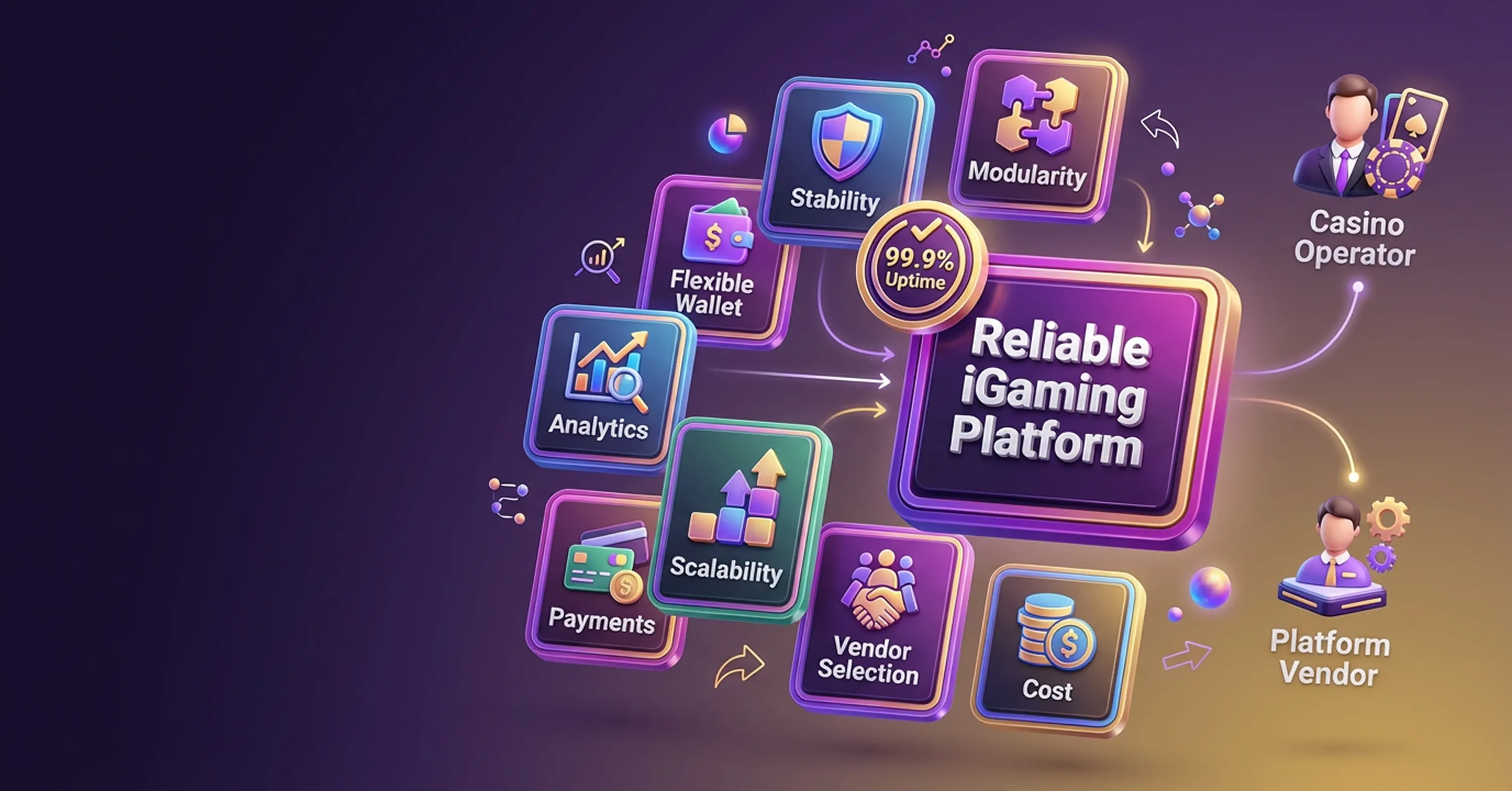
Reliable iGaming platform diagram highlighting scalability, analytics, payments, modularity, stability, vendor selection, and flexible wallet systems.

With paperwork underway, you can compare software options. Your casino platform is the engine that powers the lobby, wallet, back office, and bonus tools.

Look for:

  • Stability: 99.9 % uptime, cloud redundancy, DDoS mitigation

  • Modular design: add poker, sportsbook, or live dealer without downtime

  • Flexible wallet: support cryptocurrency, fiat, and in-game bonuses

  • Analytics: real-time dashboards, cohort tracking, smart segmentation

Consider robust, all-in-one offerings like Smart Platform, which unifies backend management, payment integrations, and thousands of games via a single system. Using an established vendor trims development time and lets you focus on player acquisition. Evaluate contract terms carefully. A revenue-share deal might reduce upfront cost yet lock you into higher lifetime fees. A one-time license plus maintenance gives more control if you have capital.

Selecting an iGaming platform that scales smoothly prevents future headaches when traffic spikes after a marketing push.

Aggregate Games Players Love

Games are the core product of any open online casino. While licensing and payments make the platform operational, the game catalog is what attracts and retains players. A broad selection keeps sessions fresh, appeals to different player types, and helps increase lifetime value.

Must-have verticals

Most successful casinos structure their libraries around a few core categories.

The most important verticals include the following:

  • Video slots: branded titles, jackpots, cascading reels, and bonus mechanics

  • Table games: blackjack, roulette, baccarat with multiple rule variations

  • Live dealer: HD-streamed tables from professional studios with chat features

  • Crash and specialty games: fast instant-win formats popular with younger players

  • Progressive jackpots: large pooled prizes that attract attention

How to source content

To build a large and competitive game library, operators typically rely on a few main sourcing methods.

These usually include:

  • Direct studio deals: partnerships with major providers such as Pragmatic Play, Evolution, or NetEnt

  • Content aggregators: single API access to thousands of games from multiple studios

  • In-house development: proprietary titles or branded slots exclusive to the platform

The simplest way to offer massive variety and stay up to date is through a game aggregation platform, such as Smart Casino, which integrates thousands of titles from leading providers. This enables monthly content updates, centralized reporting, and streamlined compliance.

Providing a deep library while maintaining a clean user interface ensures players can locate favorites quickly, which improves conversion from casual visitor to depositor.

Build a Rock-Solid Payment Stack

A real money online casino is only as strong as its payment funnel. Failed deposits mean lost marketing spend, frustrated players, and lower conversion rates.

Begin by mapping popular local methods:

  • Credit and debit cards

  • E-wallets: PayPal, Skrill, Neteller, Astropay

  • Instant bank transfer: Trustly, Interac

  • Prepaid vouchers: Paysafecard, Neosurf

  • Crypto: Bitcoin, USDT, ETH for borderless reach

For seamless, compliant, and multi-currency payment integrations—including crypto and smart routing—see Smart Pay. Compare providers on approval rates, chargeback risk, and settlement speed. Aim for at least three acquiring banks plus multiple alternative payment processors to avoid single-point failure.

Key fraud and AML tools

Alongside offering convenient payment options, operators must also protect the platform from fraud and ensure compliance with anti-money laundering (AML) regulations. Modern casino payment systems rely on automated monitoring tools that detect suspicious behavior and flag risky transactions before they are processed.

Common safeguards include:

  • Velocity checks: limits on repeated card attempts within a short period

  • Device fingerprinting: identifying devices to detect multi-accounting or fraud rings

  • Automated sanctions screening: checking players against global watchlists

  • Source-of-funds triggers: real-time alerts for unusually large or suspicious deposits

A smooth cashier that adapts to player location while maintaining strong risk controls improves conversion rates and average deposit size, directly impacting the bottom line.

Implement Responsible Gambling and Compliance

Regulators worldwide tighten player protection rules each year. Compliance should not be an afterthought.

Core features include:

  • Self-exclusion portals and time-out options

  • Deposit, loss, and session limits configurable by the user

  • Age and identity verification using KYC providers

  • Automated affordability checks for high spenders

  • 24/7 support trained in problem gambling resources

Review Top Slot Providers Driving the Online Casino Industry for a deep dive on responsible gambling modules, KYC, and AML best practices. Document every control in your policies. Regulators often ask for evidence during routine audits, so using a modern platform with integrated compliance features will help keep your casino ready for scrutiny.

Maintaining a transparent and safe environment protects both license and reputation.

Launch and Market Your Real Money Online Casino

With the platform, games, payments, and compliance framework in place, the casino is technically ready to go live. However, a structured launch process helps avoid costly issues and ensures that both the product and marketing systems perform as expected from day one.

Pre-launch checklist

Before opening the platform to real players, operators typically run through a final set of operational and technical checks.

The most important items include the following:

  • Stress-test server load with at least 5,000 concurrent users

  • Verify all game certificates and payout percentages

  • Localize site content: language, currency, cultural references

  • Set welcome bonus rules, wagering, and promotional calendar

  • Activate affiliate tracking links and test pixel firing

Growth channels that still work in 2026

After launch, the focus shifts from setup to growth.

Successful operators usually rely on several acquisition and retention channels working together, including:

  • Search: long-tail SEO around bonus codes, free spins, and new slot releases

  • Paid media: programmatic display in white-listed regions, TikTok short videos

  • Affiliates: fixed CPA or hybrid CPA plus revenue share models

  • Influencer streams: Twitch, Kick, and YouTube casino creators showcasing new games

  • Retention: email flows, push notifications, loyalty tiers, personalized offers

Combining a smooth launch with consistent marketing and retention efforts helps turn an initial release into a sustainable online casino business.

Always measure cost per first-time depositor. If a channel exceeds expected player lifetime value, pause and reallocate funds. A lean mindset keeps marketing profitable even when bidding wars heat up.

Measure, Optimise, and Scale

An open online casino is never truly “finished.” Once the platform is live, ongoing optimization becomes essential for maintaining growth and profitability. Operators rely heavily on data to understand player behavior, identify weak points in the funnel, and improve performance across the product and marketing stack.

Key areas to monitor and refine include:

  • KPIs: conversion rate, average revenue per user (ARPU), churn, fraud rate

  • Split testing: lobby layout, bonus size, email subject lines

  • Player segmentation: casual players, VIPs, sports crossover users, high churn risk

  • Expansion: adding sportsbook, bingo, or fantasy sports to increase cross-selling

  • New markets: applying for additional licenses and launching localized domains

Continuous optimisation boosts retention and lifetime value, turning a break-even launch into a long-term cash generator.

Conclusion

Launching an open online casino in 2026 may look complex, yet the journey breaks down into clear milestones: research demand, lock in a license, adopt a sturdy iGaming platform, fill the lobby with compelling games, secure seamless payments, uphold responsible gambling, and market intelligently. Follow the roadmap, track your numbers, and adjust quickly. With assets like Smart Platform and compliance partners detailed in How to Get an Online Gaming License and Operate Legally, your new casino can capture a slice of an industry projected to double by 2030.

Startup budgets vary, but most new operators earmark $250,000 to $1 million for licensing, software, game integrations, initial marketing, and working capital.

A Curaçao or Anjouan license is often the fastest and least expensive way to enter the market, though Malta or Isle of Man provide higher trust among affiliates and players at a higher cost.

Yes. Many modern iGaming platforms allow Bitcoin, Ethereum, and stablecoins. For a future-ready implementation and player appeal, consider [Crypto Casino](https://smartbet.llc/solutions/crypto-casino), which covers virtual currencies with full AML compliance.

With a white-label solution, you can launch in as little as two months. Building a custom platform and securing a tier-one license can extend the timeline to nine months or more.

Not necessarily. Some platforms, such as the one offered by Smartbet LLC, provide a unified wallet that includes casino, live dealer, and sportsbook modules.

Schedule a Meeting

Book a time that works best for you and let's discuss your project needs.

You Might Also Like

Discover more insights and articles

Futuristic blockchain casino platform with cryptocurrency payments, smart contracts, KYC verification, analytics dashboards, and decentralized gaming infrastructure.

Leading Platforms for Crypto Casino Integration

Building a successful crypto-friendly casino is a race against time, tech hurdles, and fast-shifting rules. The good news: a handful of specialist platforms already handle wallet connections, blockchain settlements, and KYC flows so operators can open the lobby faster and stay compliant. Which vendors deserve a spot on your short list? Let’s find out.

Digital illustration of iGaming platform ecosystem featuring launch, payments, games, licensing, CRM, and analytics connected across mobile and desktop devices with growth charts and security elements.

How to Start an Online Casino with Minimal Risk

Online casino revenue keeps smashing records, yet breaking into the industry can feel overwhelming. Where do you get a license, software, games, or banking? This guide shows you how to start online casino operations without staking your life savings.

Digital illustration of online slot machine with 777 symbols, free play and demo mode options, coins flying, and mobile and desktop casino gaming interface.

Best Free Online Gambling Slots to Try Today

Spin a few reels without spending a cent, and you will soon see why casual gamers and serious bettors love free slots. From risk-free testing to pure entertainment, these games open the virtual casino floor to everyone.

Online casino platform interface on desktop and mobile showing onboarding flow, game selection, and user-friendly navigation

Which Online Casino Platforms Are Easiest for Beginners?

Setting up a new gaming account or launching a fresh gaming business can feel overwhelming at first glance. You want a smooth experience without confusing menus, confusing jargon, or steep learning curves. Finding the right software interface changes everything for first-time users and operators alike.