Overview
Below is a practical guide to the solutions most casinos rely on when they roll out a second brand, expand into a new country, or bolt on a sportsbook overnight. This article breaks down nine categories of recommended software for online casino expansion.
For each category you will see:
-
What the software does
-
How it accelerates regional rollout, multi-brand management, or content integration
-
Real-world examples and quick case studies
By the end you will know which tools belong on your roadmap, the features to demand from vendors, and how successful operators knit everything together.
What Does a Consolidated KYC Suite Include?
Recommended software for online casino expansion includes scalable iGaming platforms, game aggregator APIs, payment gateway orchestration layers, CRM and loyalty engines, modular sportsbook solutions, compliance and KYC suites, real-time analytics tools, affiliate management portals, and cloud infrastructure. Together these nine components cut time to market, simplify multi-brand control, and support new games and payment methods without costly rewrites.
1. Scalable iGaming Platforms
Most expansion plans start with a platform that can handle more traffic, languages, and regulations than your original setup. But scaling successfully requires more than capacity—it requires centralized control and flexibility across markets.
A true multi-tenant casino platform offers:
-
Single back office controlling several front-end brands
-
Built-in multi-currency wallets and tax engines
-
Plug-and-play modules for live casino, bingo, and sportsbook
For expert guidance on core features, modularity, and long-term stability, see Key Features to Look for in a Casino Platform. Smartbet LLC, for instance, supplies turnkey and white-label stacks that let an operator launch a localized site in days, not months, while still using one wallet and CRM across all skins. Choose a platform architected for horizontal scaling and you will not have to replatform again when the player base doubles.
2. Game Aggregator APIs
A new market often demands a different game mix. Integrating each studio one by one costs time and certification fees. Aggregators fix that.
In practice, this means gaining access to the following capabilities:
-
Single integration yields hundreds or even thousands of slots, table games, and instant wins
-
Automatic updates keep content fresh without extra development
-
Region filters block titles not certified in a given jurisdiction
For a technical explanation of large-scale aggregation and market fit, check How iGaming Software Providers Power Modern Online Casinos.
Example in action
A Nordic casino entering Ontario used an aggregator to add 40 Ontario-approved providers overnight, letting them meet local expectations while focusing their dev team on front-end tweaks. Revenue in the first month beat forecast by 18 percent. Aggregators deliver speed to market, a wider lobby, and fewer legal headaches.
3. Payment Gateway Orchestration
Players abandon registration when they cannot deposit quickly. Expansion means supporting new cards, e-wallets, and local bank rails. As operators expand into new regions, they must support a growing mix of cards, e-wallets, and local bank rails—each with different acceptance rates, regulations, and technical requirements.
Modern orchestration layers provide:
-
Dynamic routing: choose the gateway with the highest acceptance rate for each card BIN
-
Smart retries: if a PSP declines, the system retries a fallback method in milliseconds
-
Automatic KYC linking: deposits trigger ID verification flows to remain compliant
For a detailed look at frictionless, multi-method payment stacks and automated compliance, explore Top Platforms for Multi-Currency Online Casinos. Bulletproof payments matter more as volume climbs. Europe’s online gambling segment is projected to generate €47.9 billion in revenue in 2024, and a fraction of failed deposits could equal millions lost. Treat payment orchestration as a growth lever, not a back-office chore.
4. CRM and Loyalty Engines
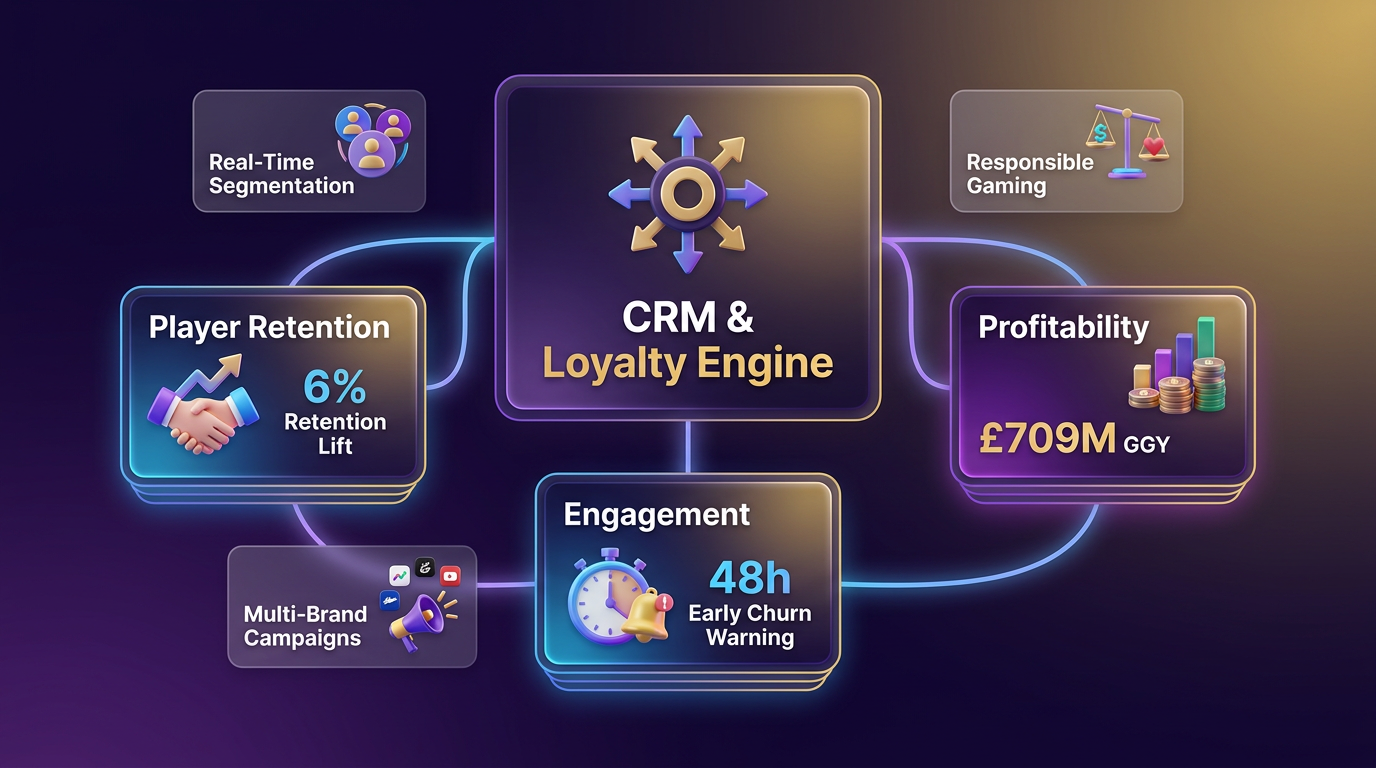
Acquiring a player is costly, and in highly competitive markets those acquisition costs continue to rise. That makes retention the primary driver of profitability, where even small improvements in engagement and lifetime value translate into significant margin gains.
Look for CRM suites that deliver:
-
Real-time segmentation reacting to in-session behavior
-
Multi-brand, multi-language campaign builders
-
Built-in responsible gaming and loss-limit logic
For advanced segmentation, automation, and loyalty workflows, see Smart CRM.
Smart use case
A UK operator, riding the wave that saw online slot GGY hit £709 million in Q4 2024, layered predictive churn scores onto its CRM. The model flagged at-risk players 48 hours earlier, lifting retention by 6 percent month over month. CRM is not just email blasts. It is data-driven loyalty that scales across all jurisdictions.
5. Modular Sportsbook Engines
Sports betting is often the first add-on when a casino brand matures, as it expands revenue streams and increases player lifetime value through cross-sell opportunities. However, integrating sportsbook capabilities introduces new operational complexity, from risk management to real-time data handling across jurisdictions.
A modular engine allows:
-
Shared wallet with casino for seamless cross-sell
-
Configurable margin and risk settings by country
-
Data feeds for pre-match, live, and virtual sports
With UK online real-event betting GGY up 38 percent to £647 million in Q4 2024, failing to offer a sportsbook leaves money on the table. Integrate a flexible book that can switch odds feeds, UI skins, and promo rules fast.
6. Compliance, KYC, and Fraud Suites
Every new region comes with its own ID rules, compliance standards, and verification workflows. Managing these differences manually quickly becomes a bottleneck as expansion scales. A consolidated KYC suite addresses this by standardizing verification across jurisdictions while adapting to local requirements.
This typically includes the following core capabilities:
-
Document scanning with OCR for passports and national IDs
-
Biometric checks: facial recognition, liveness detection, fingerprint where legal
-
Transaction monitoring for AML red flags
For a comprehensive breakdown of global compliance, due diligence, and anti-fraud protocols, visit How to Get an Online Gaming License and Operate Legally. “Technologies like facial recognition provide a virtually impenetrable layer of security” as quoted by casino CIO Ram Patrachari in an interview on future gaming tech. Automating these checks slashes manual reviews and speeds up withdrawals. Compliance tools that cover 90 percent of your global markets let you expand faster than rivals who juggle separate vendors.

7. Real-Time Analytics and BI
Expansion multiplies data volume across players, transactions, and markets, making it harder to maintain visibility into performance. Without a structured analytics layer, decisions rely on incomplete signals and reactive reporting.
High-performing BI platforms include:
-
Streaming dashboards for deposits, bets, and withdrawals
-
Player lifetime value modeling across brands
-
Geographic performance heat maps
Featured operator story: A U.S. group noticed that online gaming accounted for 30 percent of total U.S. gambling revenue in 2024 and used BI insights to shift marketing budget from land-based promotions to mobile push campaigns, adding 12 percent uplift in net gaming revenue. Decisions backed by live numbers beat guesswork every time.
8. Affiliate and Agent Management Software
Affiliates bring low-risk traffic, which becomes especially valuable when entering jurisdictions with high acquisition costs and strict advertising restrictions. As paid channels become more expensive and regulated, affiliate programs offer a scalable way to drive qualified users without upfront media spend.
Must-have functions:
-
Tiered commission schemes per brand and country
-
Real-time click, signup, and FTD tracking
-
Anti-fraud tools: duplicate account detection, traffic quality scoring
For must-have affiliate modules and supporting real-world growth, see Launching a White Label Casino: Everything You Need to Know. Smartbet LLC includes a robust affiliate module inside its platform, allowing operators to manage thousands of partners without extra logins. A transparent, self-service portal makes affiliates happy and fuels steady acquisition.
9. Cloud Infrastructure and Microservices
Physical servers struggle to keep up with seasonal traffic spikes and the latency demands of multi-region operations. As platforms expand across markets and peak events drive sudden load surges, fixed infrastructure quickly becomes a bottleneck.
Cloud stacks win because:
-
Instant scaling during big sport events
-
Local data centers satisfy residency laws
-
Microservices let you deploy game servers, wallets, and bonus engines independently
Ram Patrachari notes that cloud infrastructure “offers a wide range of gaming experiences within properties, catering to both on-site and remote players.” The global online gambling market is estimated at $78.66 billion in 2024 and could hit $153.57 billion by 2030, and cloud-native operators are poised to capture a large chunk of that growth. Build on cloud now, avoid painful migrations later.
Conclusion
Expanding an online casino is far less about luck and far more about assembling the right technology stack from the outset. Growth does not come from adding features at random—it comes from building on a platform designed for scale, flexibility, and regulatory adaptability. Operators that succeed treat expansion as a structured process: starting with a multi-tenant core platform, then integrating content aggregators, payment orchestration layers, and compliance suites tailored to each target market. From there, sustainable growth depends on visibility and optimization. Analytics platforms provide the insight needed to understand player behavior across regions, while CRM systems and affiliate management tools keep acquisition and retention funnels efficient and measurable. Each layer reinforces the others: payments improve conversion, analytics refine targeting, and affiliates extend reach without inflating acquisition costs.
When these components work together as a unified system, expansion stops being reactive and becomes predictable. Operators can launch faster in new jurisdictions, adapt to local requirements with minimal friction, and maintain consistent performance across brands and regions. Follow this structured approach, and your casino will be positioned to capture the next wave of digital gaming demand—whether in Europe, the United States, or emerging markets where competition is just beginning to scale.