neon illustration of online casino platform with slot machine, roulette, secure payment system, AI chip, and customer support icons

Key Features to Look for in a Casino Platform

Online casino revenue is rising fast, yet so are player expectations. Fail to offer the right mix of tools and content and users will tap away within seconds. So, what should operators, investors, or product managers insist on before signing a software deal?

Content authorBy Mkrtumyan GagikPublished onReading time9 min read

Overview

Below is a concise checklist, backed by market data and real-world examples, that separates modern, growth-ready casino platforms from “good enough” solutions. The article walks through the ten non-negotiable components of a competitive casino platform. You will learn why each feature matters, how it affects acquisition or retention, and what to ask vendors during due diligence. We will also reference case studies, including how Smartbet LLC uses these features to help partners launch in regulated markets. By the end, you will have a clear scorecard for any platform demo.

At a glance: 10 must-have casino platform features

The most successful casino platforms do more than simply host games. They combine player experience, operational control, marketing tools, compliance systems, and technical flexibility into a single ecosystem. Before evaluating vendors or platform architectures, decision-makers should understand the core features that separate scalable platforms from limited solutions.

Those are:

  • Mobile-first player experience

  • Advanced CRM and marketing automation

  • Flexible bonus and promotion engine

  • Affiliate and agent management tools

  • Multi-provider game aggregation

  • Payment hub with built-in compliance support

  • Integrated CMS for website and content management

  • Real-time analytics, reporting, and player insights

  • Security, fraud prevention, and responsible gaming features

  • Open APIs and modular scalability

Together, these ten features create the foundation of a casino platform that can attract players, support growth, and adapt to changing market demands.

1. Mobile-First Player Experience

Smartphones dominate play time. Mobile devices captured 87 % of global online gambling sessions in 2023. If pages stutter or lobbies feel cramped, users churn.

That includes:

  • A single codebase that adapts seamlessly to every screen size

  • Touch-friendly navigation with one-hand betting and thumb-reachable buttons

  • Lightweight progressive web app (PWA) functionality for faster access

  • Instant registration supported by biometric login and social authentication

Learn more about implementation best practices and user expectations for cutting-edge mobile casinos in Best Mobile Gambling Sites for On-the-Go Gaming. A fluid mobile flow is no longer a bonus. It is the front door to every other feature that follows.

2. Advanced CRM for Lifecycle Marketing

Acquiring new players is expensive, which is why long-term profitability depends on retention. Platforms that collect detailed player data and respond automatically to user behavior can build stronger relationships, increase lifetime value, and reduce churn.

That requires:

  • Unified player profiles that track betting activity, payments, support history, and behavioral patterns

  • Event-based automation for email, SMS, WhatsApp, and in-app messaging

  • Player segmentation based on value, risk level, or preferred games

  • Built-in fraud detection indicators and responsible gaming alerts

For a practical overview of AI-driven segmentation, campaign automation, and player analytics, explore Smart CRM.

Personalization in action

When a high-value roulette fan goes cold for seven days, the CRM can auto-issue a tailored 20 % cashback capped at $ 200. Meanwhile, casual slots players might see free spins instead, maximizing ROI per cohort.

Without an intelligent CRM, retention campaigns become guesswork. Platforms treating CRM as an optional add-on leave revenue on the table.

3. Configurable Bonus Engine

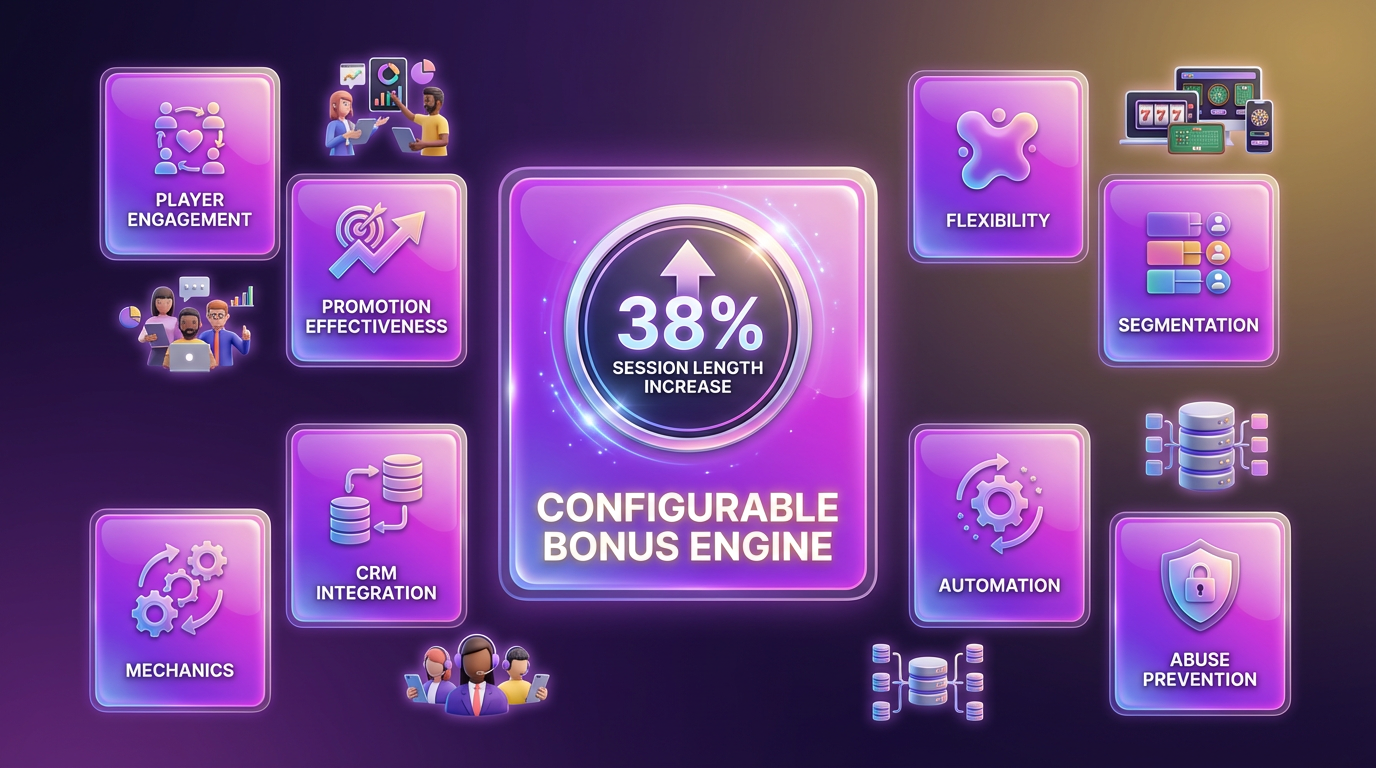
A vibrant 3D marketing visual featuring a central card for a bonus engine, surrounded by glossy cards for various benefits and features.

Promotions often create the first memorable interaction between a player and a casino platform. However, that impact disappears quickly when marketing teams are limited by rigid bonus systems that cannot adapt to different player segments or campaign goals.

That requires:

  • Support for cash bonuses, free spins, cashback, tournaments, and mission-based rewards

  • A flexible rule builder that controls wagering requirements, eligible games, expiry dates, maximum winnings, and wager contribution rates

  • Real-time wallet updates and instant player notifications

  • Abuse-prevention tools such as device limits, IP blocking, and velocity checks

For deeper insight into bonus logic, automation, and campaign performance tools, visit Smart Bonus System. An EU operator used laddered missions with decreasing rollover each level. Average session length rose 38 %, proving how varied mechanics drive engagement. A strong bonus engine pairs with the CRM to deliver the right incentive at the right time, not simply blanket offers.

4. Affiliate and Agent Management

Affiliate partnerships remain one of the most effective acquisition channels in online gambling, especially in mature markets where they can generate a large share of first-time deposits. However, managing these relationships becomes difficult when teams rely on manual spreadsheets and disconnected reporting tools.

That requires:

  • Multi-tier commission models that support CPA, revenue share, and hybrid agreements

  • Real-time reporting for clicks, first-time deposits, and net gaming revenue

  • Custom tracking links and pixel integrations for accurate attribution

  • Automated invoicing, payment withholdings, and anti-fraud controls

If you’re looking for advanced tracking, partner dashboards, and commission automation, see Smart Affiliate.

Why agents matter in cash-heavy regions

In Latin America and parts of Africa, cash agents accept deposits in person. Platforms that combine online and offline tracking capture a wider audience than “cards only” brands. Provide affiliates with transparent dashboards and they will push harder for your brand, slashing acquisition costs.

5. Multi-Provider Game Aggregation

Player retention depends heavily on content variety. When players see the same games repeatedly, they often move to another platform. A centralized game aggregation system helps operators keep the lobby fresh by continuously expanding the range of available content without increasing operational complexity.

That requires:

  • A single API that delivers slots, table games, crash games, live dealer content, and virtual sports

  • Automatic integration of new releases without additional certification work

  • Volatility and RTP tags that improve filtering and lobby organization

  • Favorites and recently played sections that make navigation easier for returning players

To see how robust aggregation boosts content variety and player engagement, discover Smart Casino.

After integrating 45 new crash and instant-win titles, a mid-size operator’s average wagers per user rose 17 % month over month. Multi-provider support is a moat. Swapping or adding games without a technical headache preserves marketing momentum.

6. Compliance-Ready Payment Hub

Deposits must feel instant, withdrawals must feel trustworthy. Regulators agree. Industry analysts stress that mobile-first onboarding, extensive live-dealer content, and bullet-proof payment processing are now “table stakes” for any platform.

That requires:

  • Support for localized cards, e-wallets, instant bank transfers, and cryptocurrency payment methods

  • Automatic KYC and AML checks triggered when specific thresholds are reached

  • Smart payment routing that improves approval rates and reduces transaction costs

  • Withdrawal and refund workflows processed within clearly defined service-level agreements

A seamless experience is powered by systems like Smart Pay, which covers cards, e-wallets, crypto, embedded KYC, AML, and rapid withdrawals. Only seven US states currently license iGaming, as documented in September 2025. Platforms must plug into state-mandated payment processors where required. A frictionless cashier converts curious visitors into loyal bettors.

7. Integrated Content Management System

A content management system may not seem as exciting as games or promotions, but it plays a critical role in how quickly a casino platform can launch campaigns and update content. Without a flexible CMS, even small changes require technical support, which slows down marketing teams and limits responsiveness.

That requires:

  • WYSIWYG editing tools for promotions, leaderboards, landing pages, and blog content

  • Native localization support with fallback text for multilingual markets

  • Built-in SEO fields for meta titles, canonical tags, and structured data

  • Scheduling tools for banners, pop-ups, and campaign content based on launch dates

If you want a full checklist of CMS and on-site marketing essentials, Choosing the Right Online Casino Platform for Your Business details required modules beyond just content.

Lightning-fast updates

During the 2024 World Cup, operators using Smartbet LLC’s CMS swapped 60 homepage hero banners within minutes, matching kickoff times and sponsor obligations without developer input. Speed to publish equals speed to profit.

8. Real-Time Analytics and Reporting

Data, or rather how fast you see it, steers profitable decisions.

Key capabilities include:

  • Live dashboards for GGR, NGR, hold percentage, and active users

  • Drill-downs by device, market, campaign, or game

  • Alert system: spikes in bet size, unusual geos, sudden downtimes

  • Export APIs feeding BI tools such as Tableau or Power BI

To learn how unified back-office analytics fuel better decisions, turn to Smart Platform.

When the global online gambling sector hit $ 78.7 billion in 2024 and is tracking toward $ 153 billion by 2030, competition intensified. Operators armed with minute-by-minute data pivot faster than those waiting on next-day CSVs.

9. Security, Licensing, and Responsible Gaming

Trust is a currency. Lose it and players vanish.

To maintain that trust, the platform should provide:

  • ISO-certified hosting, two-factor admin access, and regular penetration tests

  • Geo-fencing and VPN detection for restricted jurisdictions

  • Self-exclusion tools, reality checks, loss limits, and session timers

  • Automated reporting to regulators via secure sFTP or API

For a guide to best practices in compliance, responsible gambling technology, and regulatory readiness, explore Top Slot Providers Driving the Online Casino Industry. The overall casino gaming industry will expand by $ 43.3 billion between 2024 and 2028. Security breaches or compliance failures quickly erase a slice of that opportunity.

10. Modular Scalability and Open APIs

Growth creates new technical demands, especially when sudden spikes in traffic put pressure on the platform. Whether the increase comes from a successful campaign, a large jackpot, or expansion into a new market, the system must scale without causing downtime or requiring a complete rebuild.

To support that, the platform needs:

  • A microservice or container-based architecture that can scale horizontally

  • Versioned public APIs for games, payments, player data, and reporting

  • Sandbox environments that allow third-party developers to test integrations safely

  • The flexibility to choose between a turnkey platform and a headless front-end approach

Operators that started small on Smartbet LLC later migrated to multi-brand groups by adding front-end skins and region-specific wallets, proving how modular design future-proofs a business.

Platforms that grow as fast as the market headline keep engineering teams focused on revenue features rather than firefighting capacity. The ten areas above align with user expectations, regulatory trends, and revenue levers. Tick each box before committing to a platform license, and you will position your brand to capture share in a sector racing toward triple-digit billions.

Conclusion

The casino software space is booming and crowded. Evaluating vendors through the lens of these ten key features—mobile UX, CRM, bonus engine, affiliate tools, content, payments, aggregation, analytics, security, and scalability—cuts through sales gloss and focuses on operational impact. Use the checklist, quiz every demo, and pick a platform that delivers long-term flexibility rather than short-term fixes.

No single piece outweighs the rest, but a mobile-first experience underpins acquisition. Without smooth mobile play, even the best bonuses or content go unnoticed.

Affiliate and agent modules track clicks, deposits, and net gaming revenue in real time, automate commission payouts, and expose fraud signals, saving both money and manual hours.

Aggregating studios guarantees a steady flow of new titles, diverse mechanics, and localized themes. This variety keeps existing players engaged and attracts niche audiences at lower marketing costs.

No. A bonus engine defines promotion rules and wallet logic, while a CRM decides when and to whom those promotions are sent. Integrated, they create personalized offers that convert better.

Local card schemes, instant bank transfers, and e-wallets approved by the specific regulator are the baseline. Some jurisdictions also require payment processors to store data in-country.

Schedule a Meeting

Book a time that works best for you and let's discuss your project needs.