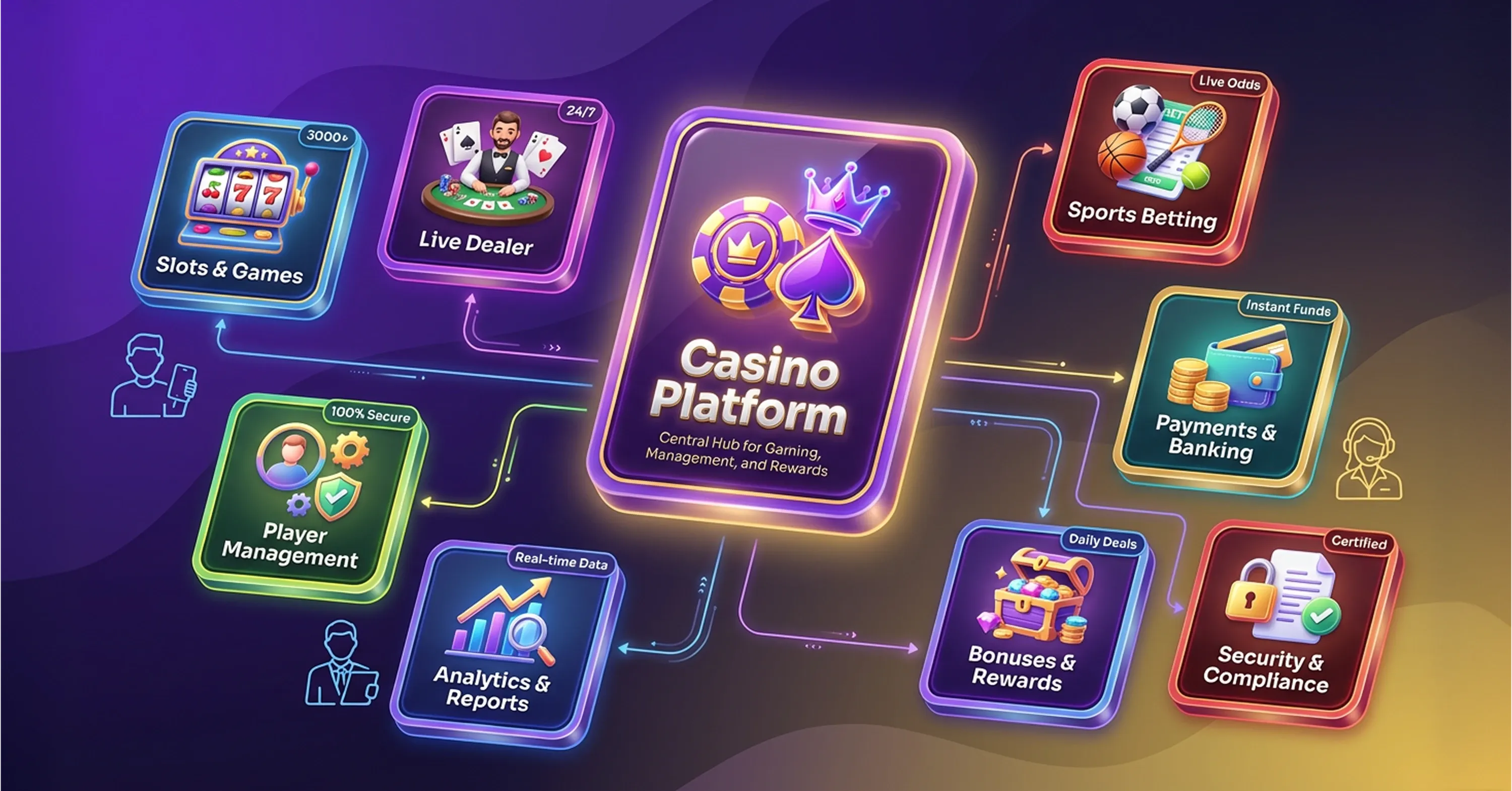
Overview
This guide breaks the process into six operator-friendly steps:
-
We compare white label and turnkey casino solution options
-
We map the licensing and compliance tasks that can trip up newcomers
-
We look at multi-provider games, aggregation, and mobile optimisation
-
We cover payments, CRM, and affiliate management
-
We share two real-world case studies that show what success looks like
Below, you will learn how the model works, what it costs, which software providers to watch, and the steps that turn an idea into a profitable gaming site. By the end, you will know which questions to ask any potential partner and which metrics decide long-term profit.
What is a White Label Casino?
A white label casino is an online gambling platform that a third-party provider builds, hosts, and licenses, then leases to operators who add their own branding, marketing, and customer management. This model slashes launch time, shifts technical responsibility to the provider, and lets operators focus capital on player acquisition and retention.
Choosing your launch model: white label or turnkey?
Most founders use these terms interchangeably, but the difference matters. Both compress timelines — they just suit different risk appetites. With a white label, the provider holds the licence, handles reporting, and shares chargeback risk. A turnkey solution gives you a fully built platform under your own licence — more control, more responsibility.
Key questions to ask potential suppliers:
-
What licence umbrella will cover my brand and target markets?
-
Can I migrate to a full turnkey setup later without downtime?
-
How is revenue shared and which costs are fixed?
Choosing the right model early saves legal headaches and renegotiations down the road. How to Launch a Brand New Casino Quickly with a Turnkey Solution breaks down how each model affects cost, control, and speed to market. For a more detailed look at the advantages and disadvantages, and a roadmap to rapid launch, you can refer to this comprehensive resource.
Securing licences and staying compliant
Regulators judge casinos on game fairness, anti-money laundering (AML), responsible gambling, and advertising standards. Even when operating under a provider’s master licence, you still need airtight procedures.
Essential compliance items:
-
KYC and age verification for every player
-
Self-exclusion tools that sync with national registers
-
Real-time AML monitoring with suspicious activity flags
-
Clear display of RTP, bonus T&Cs, and dispute resolution contacts
Comprehensive guidance on licensing pathways, compliance requirements, and multi-jurisdiction support can be found in How to Get an Online Gaming License and Operate Legally. This guide details steps for document preparation, ongoing reporting, and key regulatory obligations—offering a practical roadmap for operators at every stage.
A solid compliance record not only keeps the brand legal but also attracts payment partners and affiliate traffic.
Building the tech stack: platform, lobby, and multi-provider games

Players judge a casino by its games and loading speed. Your platform must integrate thousands of titles, handle spikes in traffic, and run smoothly on mobile.
Aggregators and content libraries
Working with one aggregator simplifies reporting and speeds up content rollout, but ensure you can negotiate individual game RTPs and bonus tools.
For robust game aggregation, platform flexibility, and detailed analytics, explore the feature set of Smart Platform, which allows seamless integration of thousands of casino titles, a customizable lobby, and cohesive back-office management.
Must-have platform features
No single feature wins on its own — your platform only performs when these components are properly integrated and pulling in the same direction. Gaps in any one area create friction that players notice and competitors exploit.
Must-have platform features include:
-
Single wallet for casino, live dealer, and sportsbook
-
Real-time data caching to minimise load times
-
Native support for Android, iOS, and responsive desktop
-
Bonus engine with free spins, cashbacks, and mission mechanics
-
Localised lobbies with currency, language, and jackpot adaptations
Mobile cannot be an afterthought. Mobile devices already drive 58% of European online casino GGR, projected to hit ~67% by 2029, according to the same. Test load times on 3G connections and optimise lobby images for small screens.
By blending a robust platform with diverse multi-provider games, you maximise both reach and monetisation.
Payments, KYC, and responsible gambling tools
Smooth deposits keep players happy and regulators calm. Each market favours different methods — from local e-wallets to open banking — so a one-size-fits-all approach rarely holds up at scale.
Vital payment considerations:
-
Coverage of local cards, wallets, and vouchers
-
Auto-settlement in multi-currency accounts to save FX fees
-
Integrated fraud scoring and charge-back management
-
Withdrawal automation with clear timeframes
KYC automation is best achieved through third-party verification APIs. These check passports, selfies, and proof of address in real time.
Pair them with a responsible gaming module that offers:
-
Deposit, loss, and session limits
-
Reality checks and time-out options
-
Self-assessment questionnaires
A transparent, player-friendly approach boosts trust and lowers customer service costs. For seamless payment processing—covering cards, e-wallets, and crypto—Smart Pay integrates robust local and digital options, automated KYC, and fast withdrawals for improved player conversion and retention.
CRM, analytics, and player retention
Getting players through the door is costly. Keeping them loyal is cheaper and more profitable — and the gap between the two is where most casino businesses are won or lost. A strong retention strategy turns one-time depositors into regulars, compounding lifetime value in a way that no acquisition budget can replicate.
A modern casino CRM should include:
-
Segmentation by value, behaviour, and risk score
-
Event-triggered campaigns, such as congratulating a jackpot win
-
Cross-channel delivery via email, SMS, push, and on-site pop-ups
-
Bonus budgeting and ROI tracking down to player level
Link the CRM with real-time BI dashboards so your team can spot churn early.
Popular metrics are:
-
Net Gaming Revenue (NGR) per segment
-
Bonus cost as a percentage of GGR
-
30-, 60-, and 90-day retention rates
To streamline player management, analytics, and loyalty tools, platforms like Smart CRM deliver powerful dashboards, player segmentation, automated workflows, and easy-to-use interfaces for retention and trust-building.
Affiliate and agent management programs
Affiliates supply warm traffic and social proof. A well-structured, transparent program can triple your monthly sign-ups without ballooning ad spend — making it one of the highest-leverage distribution channels available to a new operator.
Look for software that offers:
-
Custom commission plans: revenue share, CPA, and hybrid
-
Real-time fraud alerts for duplicate or incentivised traffic
-
Multi-currency reporting so partners see true earnings
-
Tiered rewards that nudge top partners to send more clicks
Combine this with an internal agent system if you operate in regions where on-ground promoters matter. Clear rules and timely payments win loyalty faster than flashy banners.
Real-world case studies
Case study: Sportsbook brand pivots to casino in six weeks
A mid-tier European sportsbook held a Curacao licence but had no casino vertical.
By choosing a white label casino under its existing provider, it:
-
Integrated 3,500 slots, live dealer, and crash games
-
Launched a welcome bonus package and cross-sold to 25% of its bettors
-
Recovered setup costs in four months through incremental GGR
Using the provider’s licence avoided new regulator applications and let the team focus on player conversion.
Case study: Mobile-first launch in Latin America
A start-up in Peru targeted users who deposit via local wallets.
With a turnkey casino solution from a regional supplier, it:
-
Localised payments to eight Peruvian methods
-
Kept page weight below 1 MB, slashing first load to 2.4 seconds on 3G
-
Achieved 65% mobile GGR in its first year, aligning with the European mobile trend cited earlier
Building for mobile first can match, or even exceed, desktop revenue. These stories show that the right model amplifies strengths and masks weaknesses.
Conclusion
A white label casino brings the heavy lifting of software, licensing, and compliance under one roof, freeing operators to focus on branding and customer care. By vetting providers, aligning game portfolios with target markets, and investing in real-time CRM, you set the stage for sustainable growth. Armed with the steps and data above, and by leveraging platforms like Smart Platform for a complete solution, you can move from idea to live casino faster and with far less risk.