Overview
Below, you will learn why the phrase “casino online curacao” gets repeated in boardrooms from Amsterdam to Manila, what a Curaçao license really covers, and whether it can work for your own iGaming venture.
You will see:
-
How the single-license model works
-
What it costs and how long it takes
-
The main advantages: speed, affordability, and global reach
-
Real-world case studies from brands that scaled quickly under Curaçao oversight
-
Ongoing reforms that aim to tighten supervision without killing the island’s appeal
By the end, you will be able to judge if Curaçao fits your market goals or if a stricter jurisdiction would suit you better.
What Is a Curacao Gaming License?
A Curacao gaming license is a single, all-inclusive permit issued by the island’s Gaming Control Board that lets an operator run online casino, sportsbook, poker, and lottery games globally, with typical approval in under eight weeks and annual fees around €61,000, making it one of the fastest and most affordable ways to launch a regulated iGaming brand. Curaçao has regulated remote gambling since 1996, making it one of the longest-standing jurisdictions in the global iGaming industry. The island operates a single, unified licensing framework that covers all major verticals, including casino, sportsbook, poker, bingo, and lottery.
License Structure
Master License
Granted by the Ministry of Justice prior to 1998, only four master licenses remain active today. These entities hold the authority to oversee and issue sub-licenses.
Sub-License
Issued by a master license holder to individual operators, the sub-license is the pathway used by nearly all new brands entering the market. When industry professionals refer to a “Curaçao online casino license,” they are typically referring to this sub-license structure.
Regulatory Oversight
The Gaming Control Board (GCB) currently supervises the sector. Under the forthcoming National Ordinance for Games of Chance (LOK), the GCB is expected to consolidate and formalize all regulatory functions within a modernized framework.
Market Scale and Growth
Over the past several years, Curaçao has moved from being viewed as a “starter” jurisdiction to becoming a central pillar of the global iGaming infrastructure. As regulatory reforms take shape under the new LOK framework, application volumes and license counts provide a measurable indicator of continued demand.
Curaçao’s importance in the iGaming ecosystem is reflected in its scale:
This breadth and accessibility make Curaçao a practical launchpad for start-ups as well as established brands seeking efficient international expansion. For more insights on licenses and regulatory models, see How to Get an Online Gaming License and Operate Legally.
Key Advantages for Operators

Getting licensed anywhere offers credibility and access to payment rails, yet Curaçao piles on extra perks.
First impressions matter, so let us tackle the big reasons founders keep choosing the island.
1. Fast, Straightforward Setup
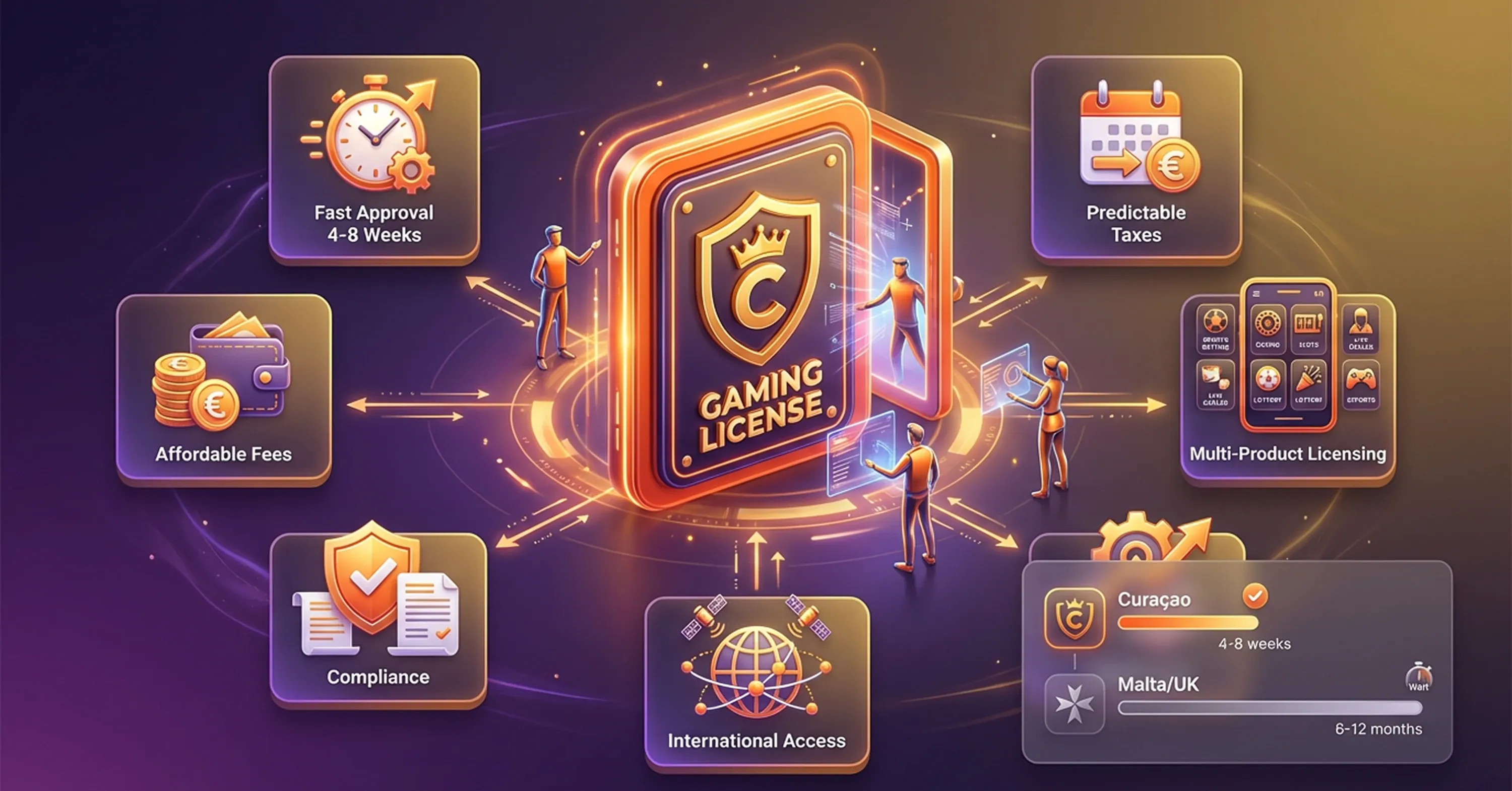
Once all required documentation is prepared and submitted correctly, the typical approval timeline ranges from 4 to 8 weeks. By comparison, licensing in jurisdictions such as Malta or the United Kingdom can take 6 to 12 months.
Core Application Requirements
Securing a Curaçao gaming license is relatively streamlined, but it is not a paperwork-free process. Regulators expect applicants to demonstrate corporate transparency, operational readiness, and a basic compliance infrastructure before approval is granted. Preparing documentation in advance can significantly shorten review timelines and prevent avoidable back-and-forth with the authorities.
Applicants should be prepared to provide:
-
Corporate documentation, including incorporation certificates, constitutional documents, and shareholder identification
-
Appointment of a local representative based in Curaçao
-
Comprehensive Anti-Money Laundering (AML) and compliance policies
-
Game fairness certification (e.g., RNG certificates) from an approved independent testing laboratory
Because the regulator reviews a single application rather than approving every new game release, updates reach the market quickly.
This speed can be a decisive edge if you want to catch a seasonal sports window or outpace a competitor. For a detailed launch roadmap and help with documentation, see How to Launch a Brand New Casino Quickly with a Turnkey Solution.
2. Affordable Fees and Predictable Taxes
According to industry sources, a Curaçao gaming license under the current framework carries an annual fee of around ANG 120,000 (about €61,000). This estimate reflects the recurring regulatory licence cost charged by the Gaming Control Board (GCB) rather than one-off service fees alone.
A typical cost breakdown often encountered in practice includes:
Compare that with €50,000-€100,000 just for the application in some European states, plus an added compliance levy each quarter. With Curaçao, you pay a flat license fee and then normal corporate tax on profit.
3. Single License, Multiple Verticals
Looking to add a sportsbook to your existing casino operation? Under Curaçao’s unified licensing model, no separate permit is required. Instead, operators typically submit a product notification to the regulator rather than undergoing an entirely new licensing process.
As a result, operators can:
-
Launch new verticals more quickly, without waiting months for additional approvals
-
Activate cross-sell strategies sooner, integrating sportsbook and casino promotions under one licence
-
Maintain lower compliance overhead, since reporting and regulatory obligations remain centralized
This flexibility is one of the key reasons Curaçao remains attractive for multi-vertical and growth-focused iGaming brands.
4. Wide International Reach
Curaçao’s framework does not impose strict geographic limitations on operators. In practice, this means licensees may target most international markets, provided the destination country has not expressly prohibited offshore gambling.
As a result, operators can design a highly flexible global strategy:
-
Enter high-growth regions quickly, including Latin America, Asia-Pacific, and parts of Africa
-
Offer diverse payment methods, such as cryptocurrency, e-wallets, and card payments, without seeking separate product approvals
-
Host infrastructure internationally, using reputable global data centers while maintaining only the required local presence in Curaçao
The net result is a lighter, more agile organization prepared to ride demand spikes in emerging markets.
Cumulatively, these elements make Curaçao the go-to “starter” jurisdiction for ambitious founders who need quick proof of concept and early cash flow.
Cost Breakdown
Many new operators worry that headline licence fees do not reflect the true cost of launching. In reality, the licence itself is only one component of a broader start-up budget that includes compliance infrastructure, local representation, and technical setup.
Below is a transparent breakdown of the typical expense ranges involved in setting up a Curaçao-licensed operation:
-
Sub-license fee: €16,000–€23,000 annually, paid to the master license holder.
-
Compliance and local agent services: €8,000–€12,000, covering regulatory support and the required on-island representative.
-
Server infrastructure: €5,000–€10,000, depending on expected traffic and hosting configuration.
-
Game certification (RNG and RTP testing): €4,000–€7,000, typically renewed every 18–24 months.
-
Legal drafting and KYC/AML tools: €6,000–€10,000 for contract templates, policy drafting, and risk screening systems.
-
Marketing reserves: €20,000–€100,000, highly variable depending on acquisition strategy (e.g., affiliate partnerships, paid traffic, or PPC campaigns).
Taken together, a realistic launch budget generally falls between €59,000 and €162,000, depending on scale, marketing ambition, and technical complexity.
Timeline
One of the key advantages of the Curaçao framework is speed to market. Compared with more heavily regulated jurisdictions, the process is streamlined, allowing operators to move from incorporation to launch without prolonged approval cycles.
From company formation to first live bet, the process typically spans 6–8 weeks:
-
Weeks 1–2: Prepare and notarize corporate documents.
-
Weeks 3–4: Submit the license application and establish hosting infrastructure (in Curaçao or a nearby jurisdiction such as Aruba).
-
Weeks 5–6: Integrate payment providers and conduct a soft launch.
-
Weeks 7–8: Go fully live and activate affiliate and marketing campaigns.
Some brands cut this to five weeks by partnering with turnkey suppliers like Smartbet LLC, which bundles platform, live casino, CRM, and payment gateways so founders can focus on user acquisition rather than technology puzzles. For practical tips, refer again to How to Launch a Brand New Casino Quickly with a Turnkey Solution.
Curaçao offers the most cost-effective runway among recognized gaming hubs, often halving both the spend and the wait versus European regulators.
Compliance and Player Protection
Critics once argued that Curaçao allowed loose oversight. The island has responded with sharper controls, especially against money laundering and underage play.
Recent upgrades:
-
Mandatory Secure Socket Layer (SSL) encryption across all pages
-
Ongoing Know Your Customer (KYC) checks, not just at registration
-
Quarterly AML audits submitted to the GCB
-
Contribution to responsible-gaming funds
Upcoming LOK reforms aim to:
-
Create a central license registry visible to players
-
Impose tiered fines for late reporting and suspicious transactions
-
Introduce a whistle-blower channel for staff and affiliates
While still less stringent than the UK or Gibraltar, Curaçao’s evolving framework gives operators enough structure to prove “reasonable effort” when regulators in other countries inquire about compliance standards. For a deeper dive into compliance must-haves—including KYC, AML, and responsible gambling controls—read Top Slot Providers Driving the Online Casino Industry.
Remember, a legal online casino cannot hide behind a license. Strong internal policies remain critical, and many brands retain outside law firms for periodic gap analysis.
Global Reach and Market Access
Why target a single European country when you can attract bettors worldwide?
Operators under Curaçao typically segment traffic into three buckets:
-
Primary growth regions: Latin America, Southeast Asia, Sub-Saharan Africa
-
Secondary expansion zones: Canada, New Zealand, select EU grey markets
-
Excluded territories: USA, France, Netherlands, and any state with explicit blocks
This broad canvas matters, given that Europe’s online gambling revenue alone hit €47.9 billion in 2024, accounting for 39 % of the continent’s total gambling activity. Meanwhile, Dutch regulators counted 450,000 residents wagering online each month.
With a Curaçao license, you can legally advertise in many markets that lack their own local licensing yet still demand safe, varied betting products.
Payment diversity is another plus:
-
Fiat methods: Visa, Mastercard, Skrill, Neteller, bank transfer
-
Crypto: Bitcoin, Ethereum, USDT, and emerging altcoins
-
Local cash vouchers for Latin American audiences
Because processors view Curaçao as a recognized jurisdiction, acceptance rates usually outperform unlicensed offshore entities.
For broader insights into payment processing and operational flexibility—including use of card, e-wallet, and crypto options—check out Choosing the Right Online Casino Platform for Your Business. Bottom line: the island’s permit acts like a passport, opening doors not just to Europe but to fast-rising economies elsewhere.
Case Studies: Success Stories
GrandSpins Ltd. – From Idea to €10 Million GGR in 14 Months
GrandSpins entered the market in mid-2022, targeting high-growth regions such as Brazil and Chile.
By combining a Curaçao sub-license with Smartbet LLC’s white-label platform, the company accelerated its launch and scaled quickly:
-
Integrated 4,500 slot titles within just three weeks
-
Rolled out a localized sportsbook ahead of the 2022 World Cup
-
Achieved break-even within five months of going live
That rapid time to market allowed GrandSpins to secure valuable affiliate partnerships and player traffic before later-arriving European-licensed competitors could establish a foothold.
NordicPlay – Testing New Verticals Safely
NordicPlay already operated under a Swedish casino license, but chose to use a Curaçao permit to test esports betting in select Asian markets, without exposing its core Scandinavian brand to regulatory or reputational risk.
Through this parallel setup, the company was able to:
-
Run A/B pricing experiments across different esports titles
-
Analyze user behavior and parlay preferences in emerging markets
-
Refine its sportsbook model before introducing proven features to its fully licensed European platform
By separating innovation from its primary regulated entity, NordicPlay reduced risk while accelerating product development. A secondary Curaçao entity can serve as an innovation lab while the main regulated arm stays untouched.
For more real-world case studies and a scalable launch playbook that leverages both white-label and turnkey solutions, visit How to Launch a Brand New Casino Quickly with a Turnkey Solution.
Challenges and Recent Reforms
No jurisdiction is without trade-offs, and Curaçao is no exception.
Operators should weigh several practical considerations:
-
Reputation risk: Some affiliates and review portals still rank Curaçao-licensed casinos more conservatively due to the jurisdiction’s historically light-touch supervision.
-
Banking friction: Certain EU financial institutions subject Curaçao-linked transactions to enhanced due diligence, which can slow onboarding or payment flows.
-
Substance requirements: Recent reforms have tightened expectations around local presence (e.g., resident directors and registered office standards), modestly increasing ongoing operating costs.
The forthcoming LOK (National Ordinance for Games of Chance) aims to address many of these concerns by modernizing the framework:
-
Eliminating the master/sub-license structure, with licenses issued directly by the regulator
-
Increasing transparency, including the publication of revocation and enforcement updates
-
Adjusting annual fees upward, though still positioning Curaçao below higher-cost EU regimes such as Malta
Finance Minister Javier Silvania has projected 40 million guilders in online gaming revenue for Curaçao’s 2025 budget, up from 30 million the previous year - an indication that tighter oversight has not dampened demand.
For founders, the message is clear: plan for higher oversight and budget a compliance buffer, but the jurisdiction will remain competitive.
Is a Curacao License Right for Your Project?
Choosing the right licensing jurisdiction is ultimately a strategic decision that should align with your timeline, capital allocation, target markets, and long-term compliance tolerance. Curaçao can be an efficient launchpad, but only if your business model matches its structure and regulatory direction.
Consider the following decision checklist:
-
You need to go live within two months
-
Your pre-marketing budget is capped at €150,000 or less
-
Your target markets do not yet require a local gambling license
-
You plan to integrate crypto or alternative payment methods
-
You are willing to strengthen compliance controls as the LOK framework continues to evolve
If at least four of these apply, Curaçao is likely a strong strategic fit. If not, another jurisdiction may be more appropriate or you may consider a dual-structure approach: one entity licensed in Curaçao for expansion markets, and a separate EU-licensed entity for fully regulated territories.
Whichever route you choose, review jurisdictional updates quarterly and engage specialized gaming counsel to stay ahead of regulatory changes and avoid costly surprises.
Conclusion
Curaçao continues to serve as one of the most attractive launchpads for new online gambling ventures, striking a pragmatic balance between cost efficiency, speed to market, and regulatory structure. Its evolving legal framework, growing international recognition, and accessible fee model explain why hundreds of founders still choose the Curaçao model, even as more demanding, high-prestige jurisdictions expand their oversight.
The decision ultimately comes down to strategy. Assess your traffic ambitions, capital constraints, and tolerance for ongoing compliance obligations. If rapid market entry and global flexibility matter more than brand prestige in heavily regulated EU markets, a Curaçao gaming license may be the strategic edge your operation needs.