Futuristic digital casino platform with slot machine jackpot, roulette wheels, crypto dashboard, and gambling analytics interface

What Is the Setup Cost for a Multi-Channel Gaming Platform?

Launching an online casino, sportsbook, and mobile app under one roof is exciting, yet the price tag can feel like a mystery box. Operators need clear numbers before they bet real money on tech, licenses, and integrations.

Content authorBy Mkrtumyan GagikPublished onReading time9 min read

Overview

A multi-channel gaming platform usually combines three verticals—casino, sports, and mobile—with one wallet and back office. The setup cost is rarely a single line item. It is a stack of fees and investments that appear during planning, integration, and the first six to twelve months of operation.

This guide walks through the eight largest cost buckets, typical price ranges, and the hidden extras that first-time operators miss. You will finish with a realistic budget template, quick benchmarking data, and tips from successful brands that went live in under a year.

What is the Setup Cost for a Multi-Channel Gaming Platform?

The setup cost for a multi-channel gaming platform falls into eight core buckets:

  • Licensing: national and local gaming permits

  • Platform software: turnkey or custom build

  • Game aggregation: casino, live dealer, virtuals

  • Sportsbook feeds: data and odds services

  • Payment processing: gateway setup and reserves

  • Compliance and security: KYC, AML, servers, audits

  • Marketing and affiliate tools: CRM, bonus engines

  • Staffing and support: trading, customer service, tech ops

Initial outlay typically ranges from $1.2 M to $6 M depending on jurisdiction, content depth, and in-house versus outsourced development.

1. Licensing and Regulatory Fees

Every operator starts with paperwork. Regulations vary by country, yet most gaming authorities charge an application fee, annual license fee, and ongoing compliance costs.

The full licensing budget usually includes several separate charges that continue long after the initial application is approved:

  • Application filing: $15 k – $100 k

  • Background investigations: $10 k – $75 k for directors and major shareholders

  • Annual license: $25 k – $500 k depending on market size

  • Compliance audits and responsible gaming contributions: 0.1 % – 1 % of GGR

A fresh European operator that targeted Malta and the UK paid $380 k in its first year for dual licensing. However, the same scope in certain Caribbean jurisdictions can slide under $120 k. These fees may look painful, yet regulated markets delivered $95.05 billion global online gambling revenue in 2023, making the paperwork worthwhile.

Building a solid regulatory foundation is non-negotiable. For an in-depth, practical breakdown of global licensing costs, hidden expenses, process steps, and strategies for long-term compliance, see How to Get an Online Gaming License and Operate Legally. Budget licensing early and keep a reserve for surprise regulatory consultations before the platform even writes its first line of code.

2. Core Platform Software

The next major decision is whether to buy an existing platform or build one from scratch. This choice has a direct impact on your launch budget, speed to market, and long-term flexibility.

A turnkey or white-label provider offers the fastest and least expensive route. Operators usually pay a setup fee of $50,000–$300,000, followed by an ongoing revenue share of 10%–25% of gross gaming revenue (GGR). In return, the provider supplies the platform, payment integrations, game content, and much of the technical support.

Custom development requires far greater investment but provides complete control over the product. Building an in-house platform typically costs $500,000–$1.5 million just to reach a minimum viable product. Operators should also budget roughly 15% of the original build cost each year for maintenance, updates, and security. The tradeoff is a much longer launch timeline, with most custom platforms taking 12–18 months to reach the market.

Smartbet LLC, for instance, offers a ready-made suite that combines casino, sportsbook, and CRM in one stack. A midsize operator in Latin America used the turnkey option, paid $160 k up front, and went live in six months, skipping a full-scale dev team. For a breakdown of the turnkey versus custom build debate—including operational trade-offs and launch speed—consult How to Launch a Brand New Casino Quickly with a Turnkey Solution.

While a custom build grants full control, most newcomers start with a turnkey platform to test markets, then reinvest profits into bespoke modules later.

3. Multi-Provider Game Aggregation
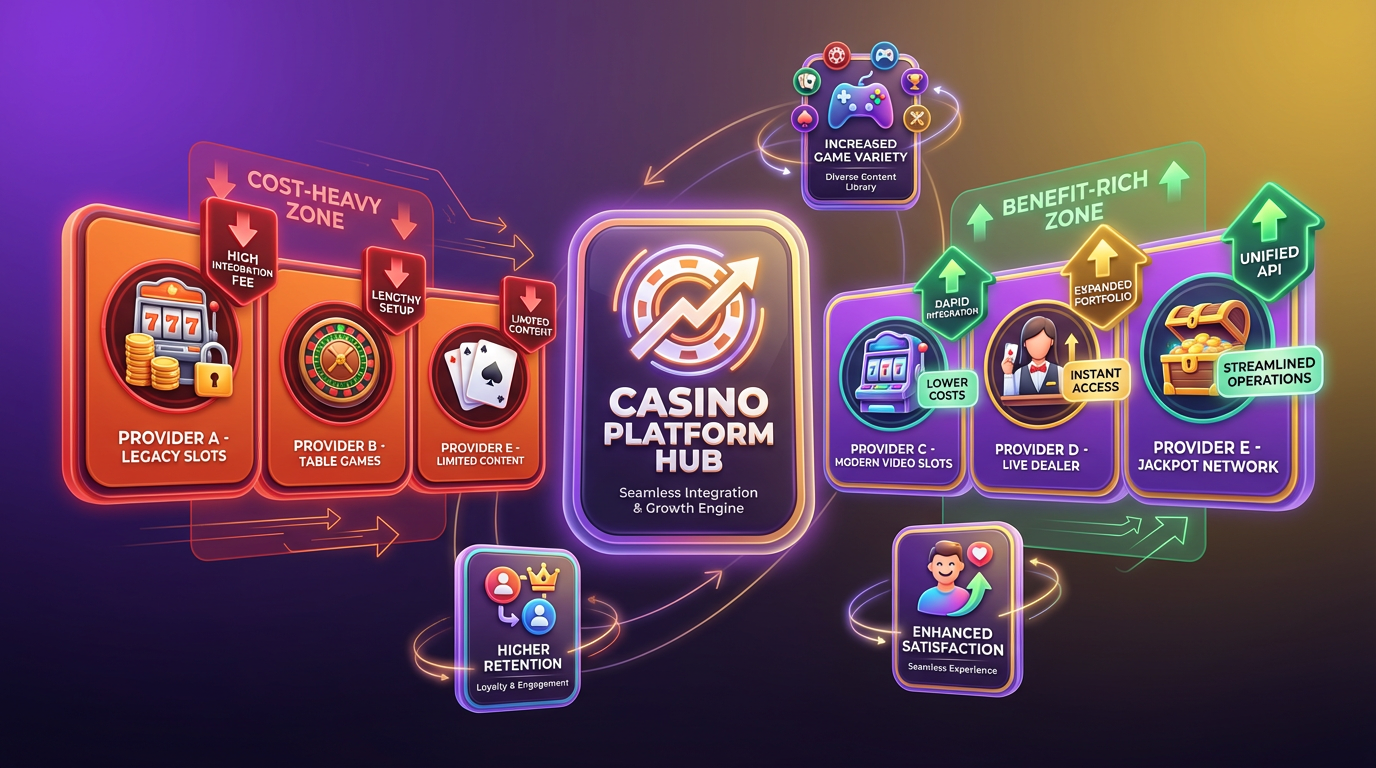
Vibrant 3D illustration of a casino platform with glossy cards showing costs and benefits, surrounded by player icons on a gradient background.

Players demand choice, so a platform needs slot studios, live casino, and specialty games.

The final cost depends on how many providers you integrate and whether you want standard slots, premium live casino content, or both:

  • Integration fees per provider: $3 k – $10 k

  • Minimum monthly guarantee (MMG): $2 k – $8 k

  • Revenue share with studios: 10 % – 18 % GGR

  • Live casino streaming tables: $5 k – $20 k per studio setup

For a look at how modern platforms streamline game aggregation and dramatically expand content libraries, explore Smart Casino, featuring thousands of games from leading studios via a single integration. The more providers you add, the higher the short-term bill, yet the larger the long-term customer lifetime value.

4. Sportsbook Data and Odds Feeds

Running a sportsbook without real-time odds is impossible. Data suppliers charge for different sports, bet types, and streaming extras.

Operators typically pay a combination of one-time integration fees and recurring subscriptions based on the breadth of coverage they need:

  • Integration: $20 k – $60 k one-off

  • Monthly data subscription: $10 k – $40 k

  • In-play video rights: $5 k – $25 k per sport per season

  • Extra features like Bet Builder APIs: $1 k – $5 k monthly

Real-world example: A challenger brand in Africa signed two feed providers. Their year-one data cost reached $420 k, yet live betting turnover accounted for 75 % of their handle within eight months, justifying the spend. For a breakdown of must-have sportsbook modules, live betting infrastructure, and scaling tips for sportsbook integration, see Top Online Gambling Platforms to Expand Your iGaming Business.

Always negotiate tiered pricing, start with top leagues, then add niche sports once revenue climbs.

5. Payments and Fraud Management

Cash flow is oxygen. Integrating safe, region-friendly banking channels is more than tech; it involves risk reserves and rolling deposits.

The true cost of payments extends beyond simple gateway access and includes several safeguards that protect the operator against fraud and failed transactions:

  • Gateway setup per PSP: $5 k – $15 k

  • Rolling reserve: 5 % – 10 % of monthly processing volume

  • KYC/AML toolkit: $1.50 – $4 per verification

  • Chargeback protection suites: $2 k – $10 k monthly

Many PSPs also demand a security deposit equal to two weeks’ volume. For an operator projecting $2 M monthly turnover, that lockup is $100 k – $200 k. To ensure seamless global payments, robust fraud filtering, and smart routing, explore solutions like Smart Pay. Budget payment costs early, because no player joins if deposits fail on day one.


6. Compliance, Security, and Hosting

Gaming data is sensitive. Regulators enforce strict hosting, encryption, and auditing rules.

To stay compliant and protect player information, operators need to budget for several layers of infrastructure and security:

  • ISO-certified hosting clusters: $8 k – $20 k per month

  • DDoS mitigation: $4 k – $10 k monthly

  • Annual penetration test: $12 k – $25 k

  • Responsible gaming tools: $0.05 – $0.20 per active player monthly

An online casino targeting Germany faced higher specs. Their hosting bill peaked at $27 k monthly during Bundesliga season due to traffic surges. The best move is to bundle hosting with a cloud provider that offers geographic redundancy, so downtime penalties do not eat into profits.

To streamline your compliance, multi-jurisdiction licensing, and regulatory monitoring, review Regulation & License for turnkey solutions.

7. Marketing Tech and Affiliate Systems

Driving traffic is expensive, yet tech infrastructure for retention is just as critical.

Operators need to invest not only in acquisition but also in the systems that keep players engaged and returning over time:

  • CRM and bonus engine modules: $15 k – $40 k setup, plus volume fees

  • Email, SMS, push packages: $0.01 – $0.05 per message

  • Affiliate/agent portal: $10 k – $25 k one-time, then 2 % – 5 % override on referred GGR

  • Social media and content management tools: $500 – $2 k monthly

A mid-tier operator using Smartbet LLC rolled out built-in affiliate dashboards. They slashed third-party software spend by $18 k annually and increased partner sign-ups by 27 % within the first quarter. Energize your affiliate operations and build high-value traffic partnerships with tools like Smart Affiliate.

Allocate at least 15 % of annual gross revenue for acquisition and retention once the platform goes live. The upfront marketing tech bill is smaller, but the ongoing ad spend can dwarf every other line item if ignored.

8. Staffing, Customer Support, and Early Working Capital

Even the slickest platform fails without people.

A sustainable operation needs experienced staff across trading, support, and compliance, along with enough cash reserves to handle unexpected setbacks:

  • Trading and risk team: $60 k – $150 k per year per trader

  • Customer support (24/7, multilingual): $3 k – $6 k per agent monthly including overhead

  • Compliance officer: $80 k – $140 k per year

  • Contingency fund: at least 3 months of fixed costs

A South-East Asian operator launched with 12 support agents, two traders, and one compliance lead. Their monthly payroll landed at $110 k. They kept six months’ payroll in reserve to absorb revenue fluctuations, a cushion that saved the business when sporting schedules thinned during an unexpected lockdown.

Pulling the Numbers Together

When all major cost categories are combined, the total investment can vary dramatically depending on the size of the launch, the number of markets you target, and the complexity of the platform.

A lean operation with one jurisdiction, a basic game portfolio, and a turnkey platform can usually launch for around $1.2 million. A more established operator entering multiple markets with broader content and stronger infrastructure often spends closer to $3.4 million. At the top end, a fully custom platform with premium sports data, multiple licenses, and top-tier game content can easily exceed $6 million.

Most new operators aim for the middle ground. They launch with a dependable turnkey platform, a smaller selection of game providers, and essential sports feeds. Once revenue begins to grow, they gradually expand into additional content, markets, and features.

Conclusion

The setup cost for a multi-channel gaming platform is a layered puzzle, not a single invoice. Licensing, software, content integrations, and human capital each carve a chunk from the budget. Operators that map out these eight buckets, negotiate phased rollouts, and keep reserves usually cross the finish line under budget and on time. With a clear plan, the initial millions become an investment rather than a gamble.

Payback depends on marketing spend, margin, and jurisdictional taxes. Operators with strong acquisition funnels often break even within 12–18 months. However, a tougher tax regime or thin margins can push payback to 24–30 months.

Yes. Many brands stagger verticals to spread costs. Starting with casino reduces data feed expenses. When cash flow stabilizes, they integrate a sportsbook module and renegotiate platform fees to keep margins healthy.

Several Caribbean and Curacao options run under $120 k including application and first-year fees. Yet, limited payment acceptance and player trust sometimes offset the savings.

White-label covers licensing, payment processing, and support under the supplier’s umbrella, while turnkey gives you more control but requires your own license. White-label is faster and cheaper up front, turnkey offers higher profit share and brand independence long term.

Keep at least three months of fixed costs—payroll, data feeds, hosting—in reserve. This buffer absorbs early revenue swings and unexpected regulatory or payment delays.

Schedule a Meeting

Book a time that works best for you and let's discuss your project needs.