What You’ll Learn
Below we break down every common fee in straightforward language, using real numbers and mini case studies so you can budget with confidence. This guide lists the seven most frequent monthly charges you will see on a turnkey casino invoice. You will discover price ranges, why each fee exists, and quick ways to keep bills lean without sacrificing quality. By the end, you will have a working cost model that turns vague estimates into hard figures.
How Much Do Turnkey Casino Platforms Cost Per Month?
Most turnkey casino operators pay $18 000–$65 000 per month in core platform and service fees, with premium brands reaching $120 000+ when they add live dealer tables, VIP support, and omnichannel marketing modules.
Cost #1: Core Platform SaaS License
Every turnkey agreement starts with a platform Software-as-a-Service fee. This covers the main dashboard, wallet, player account management, and regular version upgrades.
The exact monthly charge depends on how many players the casino serves and how much infrastructure the provider must support:
-
Typical range: $8 000–$25 000 per month
-
User tiers: 0–10 000 active players, 10 001–50 000, 50 001+
-
Billing drivers: cloud resources, data storage, and brand count
The platform fee usually scales with monthly active users (MAU). For example, a midsize European operator paying $14 000 serves roughly 12 500 MAU on a single brand. For a deeper look at what’s included and turnkey feature breakouts, see Turnkey.
Mini Case-Study: Smartbet LLC Client
A Caribbean start-up on Smartbet LLC’s turnkey stack negotiated a $10 500 monthly platform license for its first 10 000 players, plus a preset ramp-up to $18 000 once it hits 25 000 players. By locking in tiers early, the operator avoided surprise jumps later.
Keeping a close eye on player churn and server load can cut overhead. Right-sizing your instance each quarter keeps the SaaS license in the lower bracket.
The core license is the foundation, so assess it first before touching optional modules.
Cost #2: Game Provider Royalties and Updates
Slot, table, and crash-game studios rarely hand over their content for free. Most turnkey contracts bundle a game aggregation hub that remits royalties to dozens of providers.
These content agreements usually combine a percentage of gaming revenue with minimum monthly payments that protect the studios if player activity slows down:
-
Revenue share: 7 %–15 % of Gross Gaming Revenue (GGR)
-
Flat fallback: $3 000–$7 000 monthly if GGR drops below minimums
-
Update frequency: new titles every week, big engine patches quarterly
A 2023 survey showed that 83 % of iGaming revenue still comes from third-party titles, proving why studio fees matter.
Example Cost Calculation
To understand how these fees add up, imagine a casino generates $420,000 in monthly Gross Gaming Revenue. If the game studios take a standard 10% royalty, the operator pays $42,000. If the aggregation platform also charges an additional 2% markup, that adds another $8,400. In this scenario, the total monthly cost for game content and aggregation reaches $50,400.
When negotiating, ask providers for a rolling average clause so a single slow month does not trigger a flat minimum that hurts cash flow. Game royalties often outrank all other fees. Tweak your lobby mix to push studio partners that give better rev-share. For a technical explanation of game aggregation, platform flexibility, and how to efficiently source thousands of popular titles, check How iGaming Software Providers Power Modern Online Casinos.
Cost #3: Payment Gateway and KYC Fees
Your cashier keeps players depositing. Each transaction runs through payment processors, antifraud tools, and Know-Your-Customer checks mandated by regulators.
Because these services protect both the operator and the player, payment costs usually combine transaction fees with separate verification and fraud-prevention charges:
-
Card and e-wallet processing: 2.3 %–4.8 % per transaction
-
Cryptocurrency rails: 0.9 %–1.5 %
-
KYC / AML verification: $1–$3 per player check
Fintech reports place average chargeback rates at 0.6 % in iGaming, so fraud screening delivers hard savings.
Case Study: Reducing Gateway Costs
A Malta-licensed operator switched to a blended payment stack and shaved processing from 3.9 % to 2.5 %, saving $11 500 per month on a $900 000 deposit volume.
For seamless, compliant, and multi-currency payment integrations—including crypto and smart routing—see Smart Pay. Negotiate volume discounts every six months. As turnover climbs, gateway fees can drop, directly boosting your hold percentage.
Cost #4: 24/7 Customer Support and Managed Services

Turnkey suppliers often bundle multilingual chat, email, and phone support so you do not need an in-house team.
The final support bill depends on how many channels you offer and whether you need specialist services such as VIP handling or sportsbook trading:
-
Tier 1 chat & email only: $4 000–$7 000 per month
-
Full phone support with VIP desk: $10 000–$18 000
-
Add-on managed trading for sportsbook: $5 000+
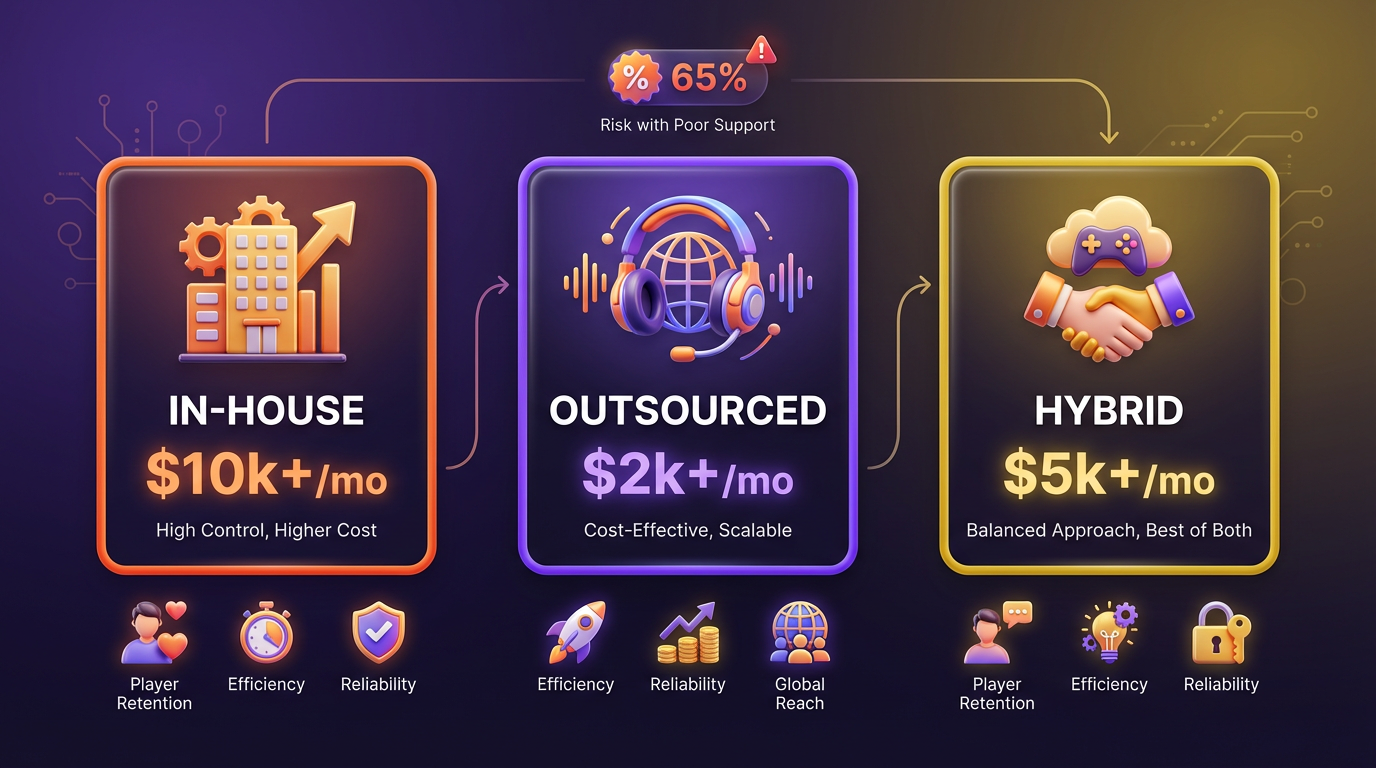
65 % of players leave after two bad service experiences which makes reliable support non-negotiable.
DIY vs Outsourced
Building an in-house support team gives you more control, but it also comes with significant staffing costs. A team of 10 agents can easily cost more than $30,000 per month once salaries, taxes, training, and management overhead are included.
By comparison, many turnkey providers offer a fully managed support desk for around $12,000 per month, removing the need to recruit, train, and supervise staff yourself.
Many operators choose a hybrid approach. They keep high-value interactions such as VIP calls and escalated complaints in-house, while outsourcing routine live chat and email support. This balance preserves the brand’s personal touch without inflating payroll. Ultimately, support costs are not just an expense—they protect player retention and long-term revenue.
Cost #5: Live Dealer Streaming and Bandwidth
Live casino remains the fastest-growing vertical, posting a 29 % YoY spike in 2022. Streaming real-time tables has special recurring costs.
Those recurring costs typically fall into three main categories:
-
Table licensing: $1 500–$4 000 per table monthly
-
Bandwidth for HD streams: $0.05–$0.11 per GB
-
Studio customization: brand overlays $500 per month
If bandwidth overruns, auto-scaling codecs or regional caching trims usage. Always pull traffic logs to forecast next month’s bill.
Cost #6: CRM, Bonuses, and Automated Marketing
Keeping players active means email drips, SMS pushes, and tailored bonuses. Advanced CRM modules sit on top of the core platform but carry their own monthly tags.
These player-retention expenses usually break down into three main areas:
-
Entry-level CRM: $2 000–$4 000
-
AI recommendation engine: +$1 500–$3 500
-
SMS and email credits: $0.004–$0.012 per message
A study shows personalized offers lift gaming revenue by 19 % which pays for the tech quickly.
Real-World ROI
One mid-size operator spent $5 000 on advanced segmentation and gained $32 000 in incremental GGR the same month. Tracking lifetime value (LTV) against CRM costs clarifies whether new tools earn their keep.
For operators who want advanced segmentation and retention features, solutions like Smart CRM deliver flexible, data-driven player management. CRM fees are variable. Start small, measure uplift, then scale modules that prove profitable.
Cost #7: Hosting, Security, and Regulatory Compliance
Even the slickest front end fails without secure hosting and licenses that let you legally accept bets.
These infrastructure and compliance costs typically break down into three main categories:
-
Cloud hosting with DDoS: $1 000–$6 000 per month
-
Game fairness and RTP audits: $3 000–$5 000 annually, amortized $250–$420 monthly
-
Regulatory reporting tools: $1 200–$2 800
Cyber attacks on gambling sites jumped 264 % last year, so skimping on security can be catastrophic. To operate legally and avoid penalties, platforms must support key compliance mechanisms, including multi-jurisdiction licensing and 24/7 monitoring—see Regulation & License.
Compliance Penalty
UKGC fines averaged £450 000 per breach. A few thousand on monitoring software is cheap insurance.
When forecasting, remember that license renewals and yearly audits hit as lump sums. Spreading them in your P&L smooths profit swings.
Typical Monthly Turnkey Casino Fee Structure
Turnkey casino pricing is rarely a single flat fee. Most providers combine a base platform subscription with recurring charges for games, payments, customer support, marketing, and compliance. The final monthly bill depends on your traffic, number of games, and how many add-on services you use.
Most turnkey casino operators pay a fixed monthly platform fee, then add variable costs tied to player activity, support, and compliance:
-
Core platform SaaS: $8,000–$25,000
-
Game royalties and content updates: 7%–15% of GGR
-
Payment processing, KYC, and fraud checks: 2%–5% of deposits
-
24/7 customer support and VIP desks: $4,000–$18,000
-
Live dealer streaming and table licensing: $1,500–$4,000 per table
-
CRM, retention, and marketing modules: $2,000–$7,500
-
Hosting, security, and compliance tools: $1,000–$6,000
Sum everything and most operators land in the $18 000–$65 000 range, with upscale brands spending past $120 000 when volumes surge.
Final Thoughts
Monthly turnkey casino costs may look like a maze, yet breaking them into seven buckets reveals a clear path. Focus first on the core platform, game royalties, and payment processing, then layer on extras that show proven ROI. With transparent budgeting, you can keep invoices predictable while still scaling fast in the competitive iGaming arena.