Digital wallet interface supporting multiple currencies and cryptocurrencies, featuring secure transactions, credit cards, and real-time financial analytics dashboard.

Typical Pricing Models for Sports Betting Platforms

Running a sportsbook is exciting until the invoices arrive. Platform fees, revenue shares, setup costs—pick the wrong mix and profits vanish. So which pricing model really fits your business?

Content authorBy Mkrtumyan GagikPublished onReading time9 min read

Overview

This guide breaks down the five pricing models you will meet when shopping for a sports betting platform: one-off license fees, recurring revenue share, pure SaaS subscriptions, setup or integration costs, and hybrid blends.

For each model you will see:

  • How it works in plain English

  • Real-world numbers, including the take rates giants like Kambi and Sportradar charge

  • Pros, cons, and typical operator profiles

  • Quick case studies to show the math

By the end, you can match your growth plans, cash flow, and risk tolerance to the right payment structure.

How Do Sportsbook Platforms Charge Operators?

Sportsbook platforms charge operators in five typical ways: 1) a large upfront license fee, 2) a running revenue share on net gaming revenue (NGR), 3) a fixed monthly SaaS subscription, 4) separate setup or integration costs, and 5) a hybrid blend that mixes any of the first four. Each model shifts risk and cash flow between supplier and operator in different ways.

1. One-Off License Fee

A one-off license fee is the classic “buy the software” model.

You pay a lump sum, receive the source code or a perpetual right to use the platform, and then handle hosting, updates, and compliance yourself.

This model usually includes several financial and operational characteristics:

  • Common ticket price: $250K–$2M depending on market coverage and modules

  • Support: often charged separately at 10–15 % of the license per year

  • Who offers it? Mid-tier European providers and boutique developers

Why choose it?

A one-time licensing model gives operators full control over the platform, allowing them to adjust odds feeds, user interface elements, and risk management tools without requiring approval from the provider. It can also reduce long-term costs for businesses that plan to operate for many years, since there are fewer ongoing fees. In addition, accounting becomes simpler because the expense appears as a single capital expenditure rather than a series of variable costs over time.

Case-Study: How an Eastern European Bookmaker Reached ROI in 18 Months with a One-Time License

A medium-sized Eastern European bookmaker bought a $600K license in 2020, spent another $120K on customizations, and now pays roughly $60K a year for support. They keep 100 % of NGR, so ROI landed inside 18 months. The flip side? Every new regulation required fresh dev sprints and legal checks costing six figures.

Choosing a license is best for well-funded operators with in-house tech teams and stable regulatory environments. For a deeper dive into comprehensive platform options and technical considerations, see Top Online Gambling Platforms to Expand Your iGaming Business.

2. Recurring Revenue Share

With a revenue share model, the platform provider receives a percentage of your net gaming revenue each month instead of, or in some cases in addition to, a large upfront payment. Most agreements fall within a range of 5% to 30% of NGR, depending on the features and services included. This pricing structure often covers hosting, software updates, and risk management tools, which reduces the operator’s technical burden. Because it requires little or no upfront capital expenditure, revenue sharing is one of the easiest ways for new operators to enter the market quickly.

Market data you can bank on

Public filings show that 69.4% of its revenue came from fixed-fee recurring arrangements while 30.6% came from revenue-share arrangements in 2023 for Sportradar. The split proves how common and profitable this model is for suppliers.

Separately, an investment memo notes Kambi’s sportsbook platform charges a low-to-mid-teens percent of operators’ net gaming revenue. Many challengers copy that template.

Pros

  • Cash-flow friendly for startups

  • Supplier incentives align with your growth

  • Continuous feature rollouts at no extra cost

Cons

  • Margins shrink as you scale

  • Hard to predict total cost in volatile seasons

  • Exit fees may apply if you migrate early

Mini-case study: Scaling Beyond a 12% Revenue Share Model

A Latin American entrant signed a 12 % NGR deal with a tier-one provider. In month three they cleared $1 M of NGR, paying $120K in fees—small compared to the marketing bill but growing fast. By month 18, NGR hit $4 M and fees touched $480K. They renegotiated to a sliding scale that drops to 8 % above $3 M NGR.

Conclusion: Revenue share suits operators chasing quick market entry and willing to trade margin for speed. For practical strategies to maximize growth and efficiency as a sportsbook operator, review Top 5 Growth Strategies for Sportsbook Operators.

3. Fixed SaaS Subscription

A fixed SaaS subscription works much like a streaming service for sportsbook operators. Instead of paying a large upfront fee or sharing a percentage of revenue, you pay a flat monthly or annual amount for access to the platform.

Most providers charge between $5,000 and $50,000 per month, depending on bet volume and the number of features included. These subscriptions often bundle together hosting, technical support, and compliance updates. Once the fee is paid, the operator keeps all additional revenue generated by the sportsbook.

Why Operators Choose It

Many operators prefer this model because it creates predictable operating expenses and simplifies budgeting. It also makes it easier to compare vendors since pricing is straightforward and transparent.

A fixed subscription becomes especially attractive during high-volume periods such as the World Cup or other major sporting events. Because there is no revenue share, operators keep all profits generated above the subscription fee.

Potential Drawbacks

Despite its advantages, this model can include hidden costs. Providers often charge overage fees if you exceed the agreed betting volume or number of tickets.

In addition, because the provider earns the same amount regardless of your growth, they may have less incentive to help you scale. Most SaaS agreements also require minimum contract commitments of two to three years.

Example in practice

An Asian daily-fantasy site pivoted into sports betting using a $12K per month SaaS deal. The flat fee let them allocate more spend to influencer marketing. When volume jumped 4x during a local derby, they paid a $3K overage instead of a revenue share that could have run into six figures.

For steady, mid-volume books, SaaS is a neat middle path between license and revenue share. If you’re exploring ways to expand your casino with seamless sportsbook integration, check out Smart Sports.

4. Setup and Integration Costs
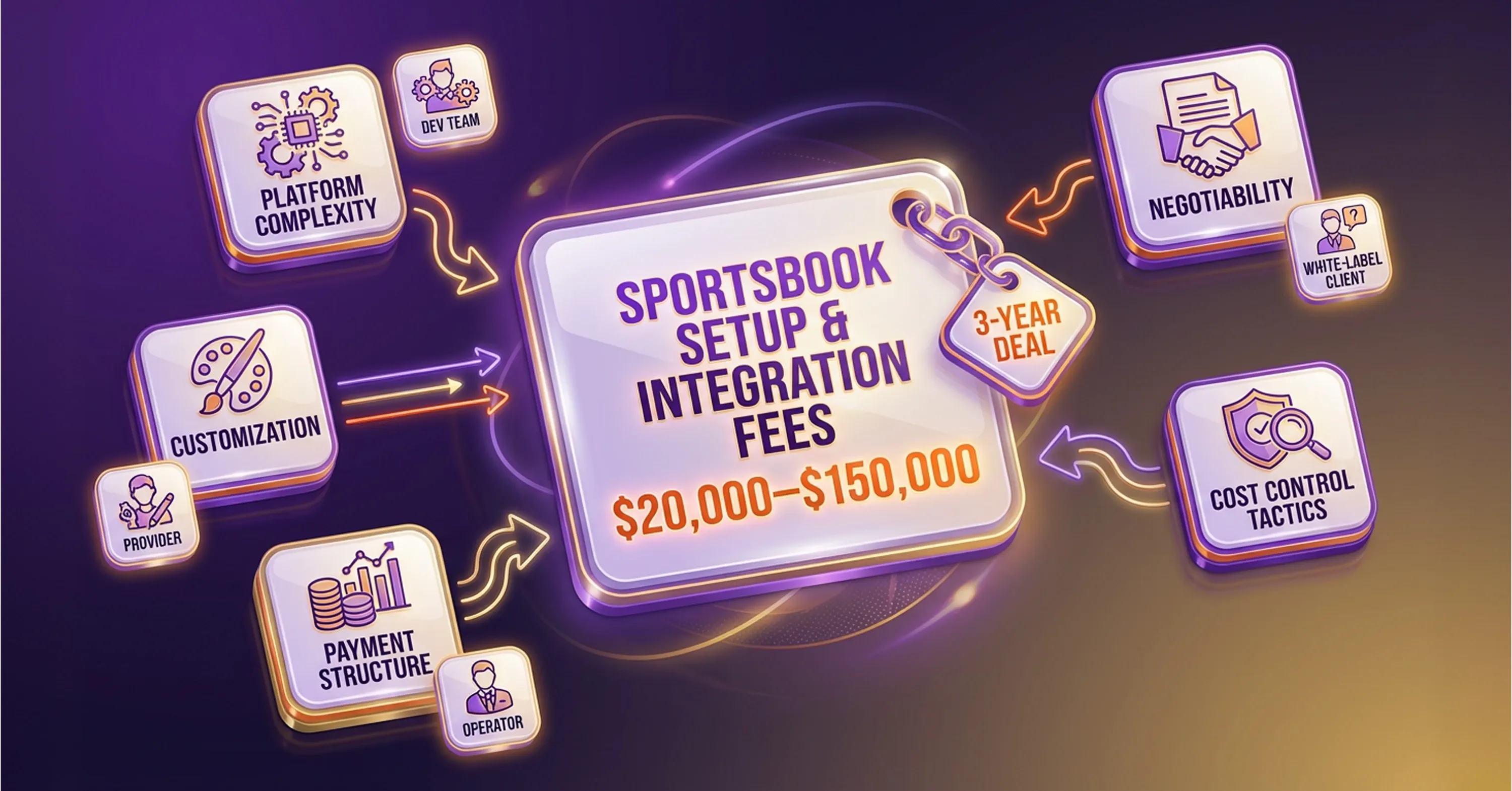
Infographic showing sportsbook setup and integration fees ranging from $20,000 to $150,000, influenced by platform complexity, customization, payment structure, negotiability, and cost control tactics.

Almost all sportsbook providers charge a separate one-time fee for setup and integration, regardless of the main pricing model. This fee usually ranges from $20,000 to $150,000, depending on how complex the platform configuration is.

What the Fee Covers

The integration fee typically includes brand customization, payment gateway connections, geo-fencing, and the technical setup required to connect odds and data feeds. Some providers require the full amount upfront, while others divide the cost into milestone payments throughout the launch process.

How to Reduce Costs

Operators can lower these expenses in several ways. Reusing existing payment processors and KYC vendors avoids unnecessary new integrations. Supplying logos, graphics, and other brand materials in the provider’s preferred format also reduces design work. Choosing standard templates instead of fully custom front-end designs is another effective way to keep setup costs under control.

Quick math

If a provider quotes $80K for basic integration but your dev team handles front-end skinning, you might cut that to $50K. Over a three-year deal, the delta equals another marketing campaign.

Smartbet LLC, for instance, bundles moderate setup costs into its turnkey offer, while white-label clients pay à la carte. Knowing which tasks you can do in-house keeps bills honest.

Wrap-up: Treat setup fees as negotiable, especially when you bring long-term volume to the table. For broader guidance on selecting and integrating casino and sportsbook technology, see Choosing the Right Online Casino Platform for Your Business.

5. Hybrid Structures

Most mature sportsbook operators eventually move toward a hybrid pricing structure. Instead of relying entirely on one payment model, they combine elements such as a lower upfront license fee with a smaller share of revenue, or a fixed SaaS subscription with performance-based bonuses.

Common Hybrid Structures

A common approach is to pair a software license with ongoing maintenance and a low revenue share, often in the range of 3% to 5%. Other operators choose a SaaS base fee combined with a tiered revenue share that only applies once the sportsbook exceeds certain revenue targets. Some agreements also include a revenue share that gradually decreases each year until it reaches a fixed minimum.

Why Operators Prefer Hybrid Models

Hybrid pricing works well because it balances risk and reward for both sides. Operators reduce their initial cash burden while avoiding the high long-term costs of a full revenue share agreement. At the same time, providers still benefit from the operator’s growth, which gives them an incentive to continue improving the platform and adding new features.

Case spotlight

A US tribal casino negotiated a $250K license, $10K monthly support, and 6 % revenue share for online bets in states beyond its land-based footprint. Year one totals: $380K fixed costs plus $900K variable share on $15M NGR. By stacking models, both sides felt protected.

Hybrid models reward operators with bargaining power and a clear multi-year growth plan. To further explore what it takes to launch and operate profitably in the industry, consult How to Establish a Successful Gambling Company.

Putting It All Together

Selecting a pricing model is less about the sticker and more about your roadmap.

The right choice depends on your stage of growth, available capital, and how much risk you are willing to take during the early phases of the business:

  • Just launching, minimal capital? Lean toward revenue share or SaaS.

  • Established brand with strong cash reserves? A license can cut long-term costs.

  • Unsure about volume swings? Hybrid lets you hedge.

Before signing, model best- and worst-case scenarios over three to five years. Include hidden factors: compliance fines, payment processing, and marketing.

Conclusion

Sportsbook platforms may look similar on the surface, but their pricing models can reshape your P&L. License fees front-load the cost, revenue share spreads it, SaaS makes it predictable, setup fees add friction, and hybrids try to balance everything. Map each option to your goals, simulate the cash flow, and remember that the best model is the one you can live with during both winning streaks and droughts.


The low-cost entry route is usually a revenue share deal with minimal upfront fees. You pay only when you generate net gaming revenue, which keeps early cash burn low.

SaaS charges a fixed monthly amount tied to user or ticket tiers, while revenue share takes a percentage of your net gaming revenue. SaaS offers cost predictability, whereas revenue share aligns supplier incentives with your growth.

Yes, but contracts often have lock-in periods or exit penalties. Negotiate migration clauses upfront and set clear performance triggers that allow you to revisit the fee structure after hitting specific milestones.

Most providers will flex on setup costs if your projected handle or territory potential is attractive. Bringing resources like existing payment integrations to the table strengthens your position.

New operators usually benefit most from either a revenue share or SaaS model. Revenue share minimizes upfront costs, while SaaS provides predictable monthly expenses. The better option depends on whether you prioritize conserving cash or maintaining fixed operating costs.

Schedule a Meeting

Book a time that works best for you and let's discuss your project needs.