futuristic neon-lit casino environment with a slot machine displaying triple sevens, surrounded by digital graphics, roulette table, and animated data visuals

Must-Have Tools for Sportsbook Management

Sports betting moves fast: lines shift in seconds, players expect instant payouts, and regulators watch every transaction. Without the right toolbox, an operator can lose both margin and customers before noticing something went wrong.

Content authorBy Mkrtumyan GagikPublished onReading time10 min read

Overview

Below is a clear look at the software and services that keep modern sportsbooks profitable, compliant, and ready for scale. You will discover seven essential toolsets that power efficient sportsbook operations. We will cover what each tool does, why it matters, and how real operators have applied it to grow handle and protect margin. Expect concise explanations, quick bullet lists, and practical takeaways you can act on today.

The online gambling market is projected to reach $153.57 billion by 2030, and sports betting already makes up over 50% of global online gambling revenue. With so much at stake, the difference between thriving and merely surviving is often the quality of your tech stack.

Core Components of a Complete Sportsbook Management Platform

A successful sportsbook operation depends on more than just offering betting markets. Operators need a complete management setup that combines risk control, player engagement, reporting, and seamless access across every channel.

That includes:

  1. Risk management and trading software

  2. Real-time odds compilation and market monitoring

  3. Reporting and business intelligence dashboards

  4. Mobile support for both players and agents

  5. Multi-channel integration across web, retail, and API environments

  6. CRM and player engagement tools

  7. Secure payment processing and KYC verification gateways

Together, these components create a sportsbook platform that can manage risk, improve player experience, and support long-term operational growth.

Risk Management and Trading Software

Sports betting margins are often narrow, which makes effective risk management essential. Operators need tools that can detect unusual activity early, limit exposure, and give trading teams enough time to respond before a profitable market becomes a liability.

Core capabilities include:

  • Instant identification of sharp or unusual betting activity

  • Automatic adjustment of betting limits by player, sport, or market

  • Real-time detection of correlated wagers and arbitrage opportunities

  • Immediate alerts sent to traders when exposure begins to increase

  • Visual dashboards that show liability and risk across all active markets

Learn more about how to guard against market manipulation and volatility with Risk Management.

Automated Limit Management

Modern sportsbooks use automated limit tools to manage player risk more precisely. Instead of applying the same limits to every account, the system assigns a dynamic risk score based on betting behavior, account history, and potential signs of coordinated activity.

For example:

  • A new player with no betting history may receive a low initial stake limit

  • A VIP player with consistent activity may receive higher limits, but with increased monitoring

  • Accounts that trigger syndicate or arbitrage signals may face reduced stakes or temporary market restrictions

A sportsbook using granular limits can save up to 2 % of annual GGR, which often equals a full percentage point of net profit.

Case Study: Starlight Sportsbook

Starlight, a mid-tier operator in Latin America, integrated risk software in 2023.

Within six weeks:

  • Flagged 112 suspicious accounts

  • Cut exposure on a single NBA player prop from $240 k to $35 k

  • Improved hold percentage from 6.2 % to 7.1 %

Their head trader credits the difference to “alerts arriving while we still had time to move the line.”

Consistent risk control tees up everything else, so the next toolset builds on that foundation.

Odds Compilation and Real-Time Monitoring

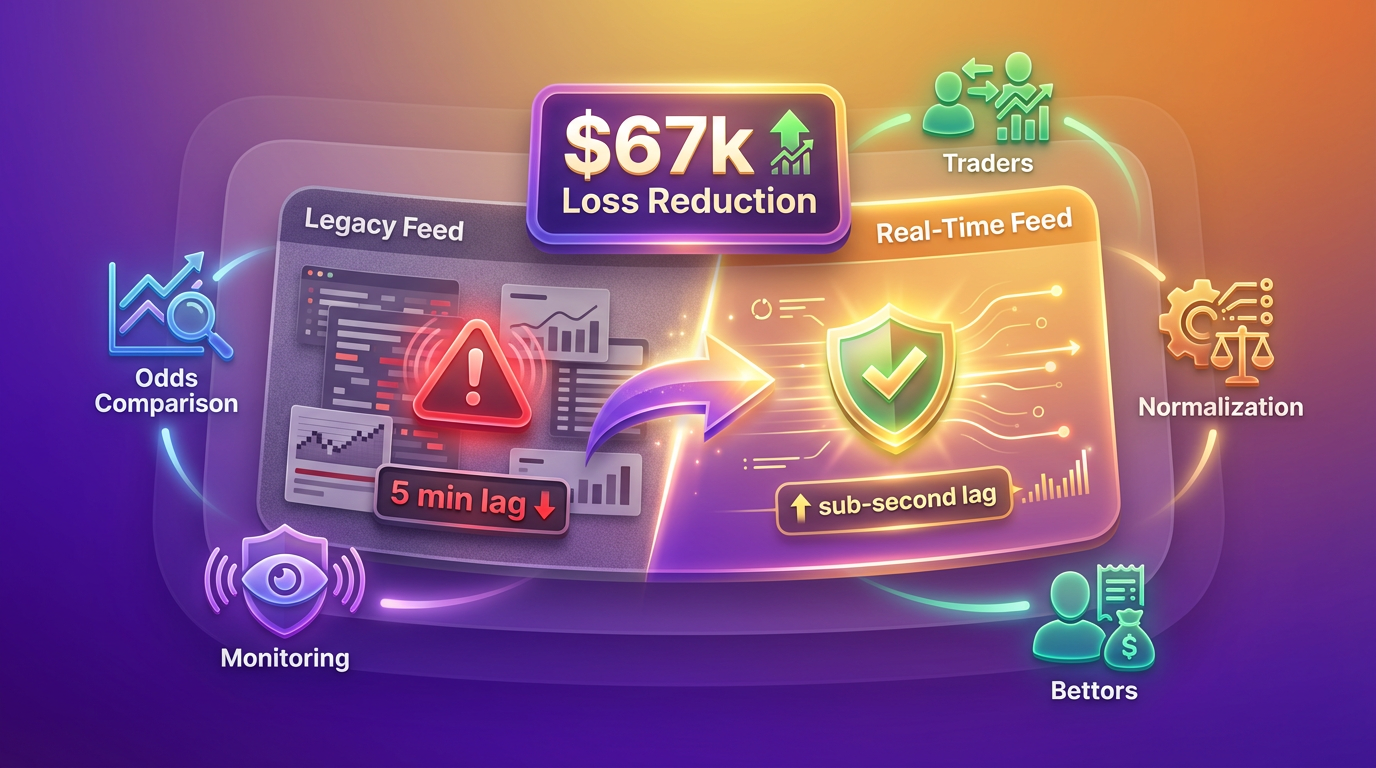
A vibrant 3D marketing visual showing a split card transforming from a cluttered 'Legacy Feed' to a glowing 'Real-Time Feed' with icons.

Accurate odds are just as important as strong risk management. Modern bettors compare prices across multiple sportsbooks in seconds, which means outdated or uncompetitive odds can quickly lead to lost bets and lower player retention.

A strong odds management system should provide:

  • Prices collected from multiple global exchanges and data providers

  • Automatic normalization across decimal, fractional, and moneyline formats

  • Built-in margin controls that apply your target hold percentage automatically

  • Instant distribution of updated odds to websites, mobile apps, retail terminals, and affiliate channels

To strengthen the odds feed, operators should also include monitoring tools that help traders react quickly to market changes. Color-coded deviation alerts can highlight when a line moves too far from the broader market, making unusual pricing easier to identify. Historical odds charts give traders a clear view of how prices have shifted over time, while an override panel allows them to adjust margins, change pricing, or suspend a market with a single click. For a deeper breakdown of sportsbook modules, live odds technology, and scaling real-time risk management, see Top Online Gambling Platforms to Expand Your iGaming Business.

Real-World Fix: MetroBet

MetroBet noticed a spike in NFL arbitrage tickets each Sunday. After adding deviation alerts, traders spotted a five-minute lag from their legacy feed. Switching to real-time feed software reduced the lag to sub-second and cut arbitrage losses by $67 k in the first quarter. With odds now accurate, management needs to see the full financial picture.

Reporting and Business-Intelligence Dashboards

Data is useless if hidden in CSV files. Modern BI dashboards turn raw wagers into insights anyone can read.

Key widgets to include:

  • Handle, hold, and margin by sport, league, and market

  • Geo heatmaps of active bettors

  • Churn probability and lifetime value estimates

  • Cross-sell performance from sportsbook to casino

For actionable analytics and player management, check out the benefits of Smart CRM, which delivers real-time dashboards, segmentation, and automation.

Custom KPI Alerts

Operators should define clear alert thresholds so teams can respond before small problems become costly. Automated notifications delivered through email, SMS, or Slack help ensure that the right people know immediately when key performance indicators move outside acceptable ranges.

For example, alerts can trigger when:

  • Daily hold falls below 3%

  • Parlay bets account for more than 25% of total handle

  • Deposit failure rates exceed 5% in a specific country

Real-time alerts reduce response times and help operators protect revenue, player experience, and platform performance.

Case Study: NorthSea Gaming

NorthSea Gaming built a custom dashboard pulling data through an API from their platform vendor, Smartbet LLC. Management trimmed weekly reporting time from six hours to 30 minutes and identified a profitable tennis odds niche worth $1.2 m annually.

Good data drives mobile strategy, so let’s shift to mobile tools.

Mobile Support for Players and Agents

More bets are placed on phones than desktops. A 2023 Statista report shows 80 % of online wagers come from mobile devices.

What mobile support really means:

  • Native iOS and Android apps with biometric login

  • Lightweight web app for regions that restrict store downloads

  • Agent interface to place bets on behalf of customers in retail or via chat

  • Push notifications for price boosts, cash-out offers, and risk alerts

If you're prioritizing for mobile success, explore the features of Best Mobile Gambling Sites for On-the-Go Gaming.

Fast Bet Slip and One-Tap Cash-Out

Seconds matter.

A streamlined slip includes:

  • Pre-filled stake suggestions

  • Auto-accept odds changes toggle

  • Confirmation haptics so users know bet is accepted

Players stay longer and wager more when the app feels instant.

Case Study: QuickWager Africa

QuickWager launched a one-tap cash-out feature, and average bet frequency per user rose from 5.1 to 7.4 per week within a month. Compared with their desktop site, the app generated 38 % higher GGR per player. Mobile is a channel, but true growth comes from unifying all channels.

Multi-Channel Integration Platform

Customers move between retail shops, affiliate sites, and branded apps. Operators need a single wallet and consistent limits.

An integration layer should:

  • Share wallet and bonus balance across web, mobile, and retail POS

  • Sync bet history so customer support sees everything in one view

  • Expose REST and WebSocket APIs for third-party partners

  • Handle failover so settlements continue during provider outages

For details on scalable integrations and unified platforms, see How iGaming Software Providers Power Modern Online Casinos.

Unified Promotion Engine

A centralized promotion engine helps operators manage campaigns more effectively and avoid conflicting offers. Without a single system controlling bonuses, players may receive overlapping promotions that reduce profitability and create a confusing experience.

A strong promotion engine should:

  • Prevent players from activating multiple free-bet offers at the same time

  • Automatically remove bonuses once wagering requirements have been completed

  • Support highly targeted campaigns for specific channels, markets, or player groups, such as retail-only odds boosts

This level of control makes promotions easier to manage, improves player experience, and helps operators protect promotional budgets.

Case Study: BetCentro

BetCentro merged its old retail system with Smartbet LLC’s API stack. Revenue from cross-channel customers grew 22 % year over year, while support tickets on bonus discrepancies fell by 70 %.

Once channels are aligned, you still need to engage players intelligently.

CRM and Player Engagement Tools

Retention often costs less than acquisition. A purpose-built gaming CRM makes each message relevant.

Must-have CRM features:

  • Real-time segmentation based on bet type, stake level, and activity gap

  • Journey builder for onboarding, reactivation, and VIP nurturing

  • Embedded A/B testing on subject lines and bonus size

  • Integrated fraud scoring to block bonus abuse automatically

Example Workflow – The Dormant Punter

When a customer remains inactive for seven days, the system can automatically send a personalized free bet credit designed to encourage them to return. If the player claims the offer, the platform can immediately follow up with an additional promotion, such as an odds boost tied to that player's preferred team or betting market. If the offer goes unused, the workflow can escalate automatically and schedule a call or direct outreach from a VIP manager.

Operators that use similar reactivation journeys report increases of up to 15% in monthly active users. However, even the strongest engagement strategy loses value if players encounter problems when they try to deposit or withdraw funds.

Payment and KYC Gateways

Smooth deposits and withdrawals are central to trust and compliance.

Payment/KYC toolkit checklist:

  • Multiple local payment methods: cards, e-wallets, bank transfers, crypto

  • Automated document verification with OCR and selfie match

  • Real-time AML screening and sanctions checks

  • Withdrawal rules engine (daily limits, cooling-off periods, source-of-funds triggers)

For seamless processing (including crypto and robust KYC), review Smart Pay, which automates payment routing, compliance, and security.

Case Study: AlpineBet EU

By replacing manual ID checks with an automated gateway, AlpineBet cut average withdrawal approval time from 24 hours to 35 minutes and saw a 9 % increase in repeat deposits within two weeks.

Reliable payments close the loop in a setup that began with risk management. Each tool supports the others, forming a resilient framework for growth.

Conclusion

Running a winning sportsbook requires more than sharp odds. You need integrated risk controls, instant data, mobile reach, unified channels, smart CRM, and frictionless payments. Together, these seven must-have tools build a stable backbone that protects margin, pleases regulators, and delights customers in a market racing toward $153.57 billion in value.

Invest wisely in each layer, and your operation can stand out even as competition, and stakes, grow higher.

Sportsbook management software is a collection of tools that automate odds creation, bet acceptance, risk control, reporting, payments, and player engagement so an operator can run a legal, profitable betting business with fewer manual tasks.

They track every wager and player in real time, spot unusual betting patterns, cap stakes automatically, and alert traders to move lines or suspend markets before large liabilities build.

Because lines change constantly across global markets, real-time feeds ensure your site always shows accurate prices, reduces arbitrage exposure, and keeps your offering competitive with major sportsbooks.

Yes. Providers like Smartbet LLC offer unified platforms where the same wallet, CRM, and reporting suite drive both verticals, making it easier to cross-sell and comply with regulations.

Implement a gaming-specific CRM that sends targeted bonuses and messages based on actual betting behavior instead of generic blasts. Personalized offers keep customers active and reduce churn.

Schedule a Meeting

Book a time that works best for you and let's discuss your project needs.