Online casino slot machine with gaming analytics and performance dashboards

The Rise of Live Gambling Games: What Operators Need to Know

The online gaming industry is currently witnessing a massive shift toward authenticity and interaction. Players are no longer satisfied with solitary, algorithm-driven experiences; they want the energy of a physical casino floor delivered directly to their screens.

Content authorBy Mkrtumyan GagikPublished onReading time9 min read

Overview

This article examines the explosive growth of live gambling games, the technology that powers them, and the strategic steps operators must take to capitalize on this trend. We will explore market data, integration strategies, and the essential components required to launch a successful real-time gaming offering.

Understanding Live Gambling Games

Live gambling games are online casino games run by human dealers in real-time, streamed from professional studios or land-based casinos directly to a player's device. Unlike standard online games that rely on Random Number Generators (RNG) to determine outcomes, these games use real cards, roulette wheels, and dice. The action is captured by multiple high-definition cameras and encoded instantly, allowing players to place bets through a digital interface while watching the physical game unfold.

The appeal lies in the hybrid nature of the experience. It combines the convenience of online play with the trust and social atmosphere of a brick-and-mortar venue.

This blend of digital access and real-world authenticity is driven by several key elements:

  • Human Interaction: Players can chat with dealers and sometimes other players.

  • Transparency: Every card shuffle and wheel spin is visible, eliminating doubts about fairness.

  • Immersion: High-quality audio and multiple camera angles create a TV-quality production.

While the concept seems simple, the execution requires sophisticated logistics. Studios must operate 24/7, employing hundreds of dealers and utilizing advanced Optical Character Recognition (OCR) technology. This tech translates physical card values into digital data that the software can read, ensuring that payouts happen the instant a round ends.

The Surge in Popularity and Market Growth

The demand for live dealer games is not just anecdotal; hard data supports the upward trajectory of this vertical.

Recent financial reports from major industry players highlight this aggressive expansion. For example, Evolution AB’s 2024 year-end report shows that their Live Casino offering grew by 13.3 % year-on-year in the fourth quarter. The same report noted that the company ended the year with over 1,700 live casino tables, an increase of about 100 tables from the previous year. This indicates that supply is ramping up to meet a voracious player demand.

Broader market analysis confirms that this is an industry-wide phenomenon. The EGBA’s 2025 Annual Activity Report revealed that combined online gross gaming revenue reached €13.5 billion in 2024, a 15 % increase compared to the prior year. Furthermore, the report stated that casino games accounted for €7.0 billion, or 51 %, of the total online revenue.

For a deeper look at global and regional industry benchmarks, market growth rates, and how live dealer games are reshaping the landscape, see Best Online Gambling Platforms in 2025: Where to Play Safely.

Why Players Are Switching

The shift toward a real-time casino experience is driven by several psychological and practical factors.

First, trust is a major component. Even though RNG software is audited and fair, some players remain skeptical of computer-generated results. Seeing a physical ball land in a pocket provides a level of reassurance that code cannot replicate.

Second, the entertainment value has evolved. Modern live games are not just static streams of a blackjack table. They are fast-paced game shows with hosts, bonus rounds, and augmented reality elements. This attracts a demographic that might not be interested in traditional gambling but enjoys the spectacle of interactive entertainment.

Consequently, operators who fail to integrate a robust live offering risk losing a significant portion of their audience to competitors who do.

Key Components of a Successful Live Casino

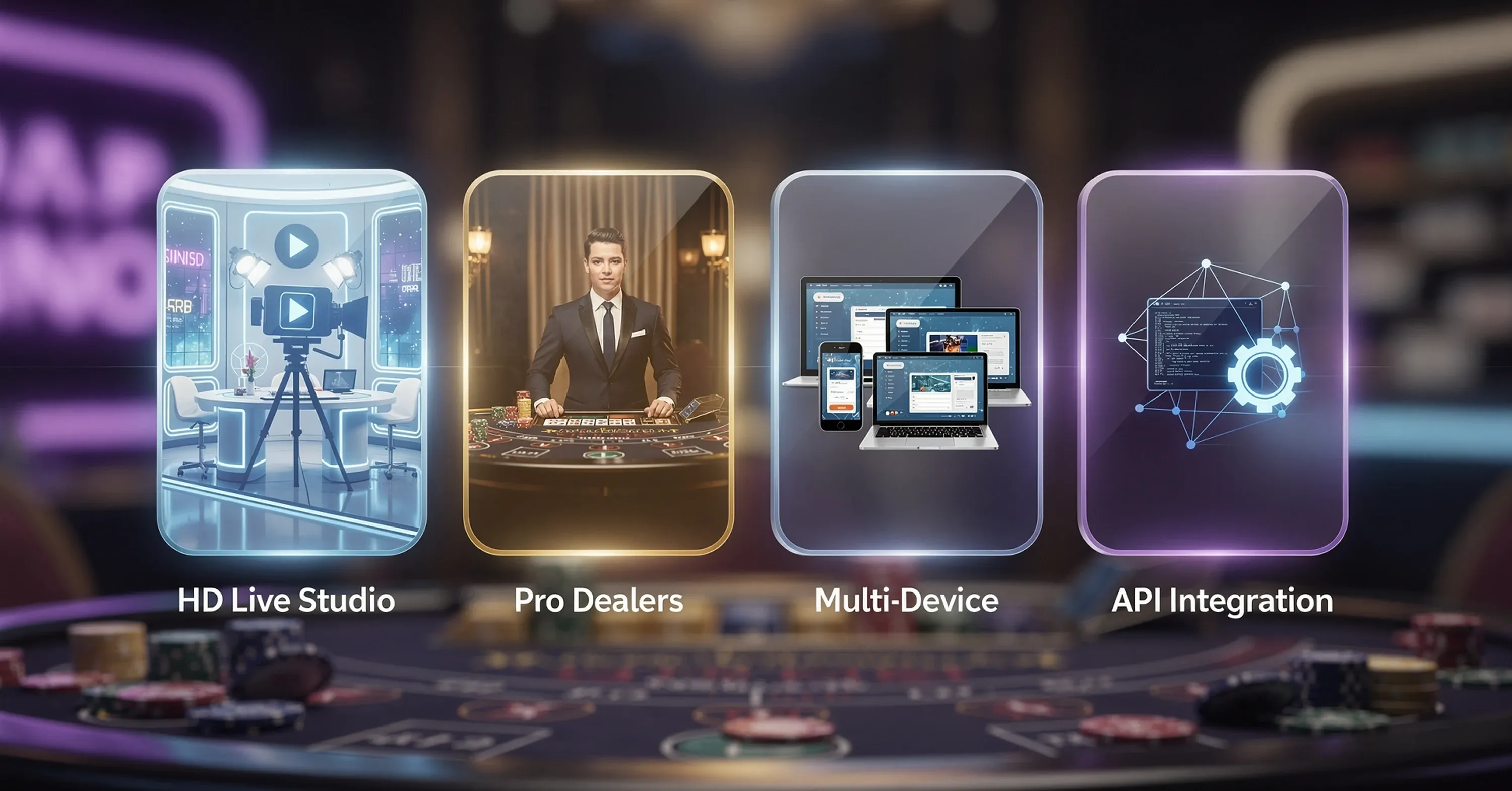
Live casino platform features including HD studio, pro dealers, multi-device access, and API integration

Launching a live product involves more than just adding a video feed to a website. It requires a deep understanding of the necessary infrastructure and user experience.

A successful operation relies on high-definition streaming with ultra-low latency. If a video feed lags by even a few seconds, the betting window closes before the player sees the action, leading to frustration and lost revenue. The user interface (UI) must be intuitive, overlaying the betting grid on the video feed without obstructing the view of the dealer or the game results.

Delivering this seamless experience depends on several critical production and technical standards:

  • Studio Quality: Professional lighting, soundproofing, and set design are non-negotiable.

  • Dealer Professionalism: Dealers act as brand ambassadors; they must be trained in game rules and player engagement.

  • Device Compatibility: The stream must adapt quality automatically for mobile data vs. Wi-Fi connections.

For a practical view on delivering a premium live casino experience, including branded tables, multi-camera streams, and multilingual support, explore Smart Live.

Technology and Software Integration

Most operators do not build their own studios due to the immense cost and management overhead. Instead, they partner with established B2B providers. This is where seamless API integration becomes critical. The goal is to have the live lobby sit naturally within the operator’s existing platform, sharing the same wallet and account system.

Companies like Smartbet LLC have emerged to fill this need, offering iGaming technology that provides comprehensive online casino solutions. By utilizing a platform that includes live casino streaming with professional dealers and API integration, operators can launch a world-class live section without managing the physical logistics themselves.

Effective integration also means the back-office system must be robust. Operators need real-time data on player activity, risk management tools to detect collusion at live tables, and the ability to offer bonuses specifically for live games.

If you're seeking details on platform integration, content aggregation, and the technological fundamentals that support high-performing, scalable casinos, see Top Online Gambling Platforms to Expand Your iGaming Business.

Implementing Live Dealer Games for Operators

For an operator looking to enter or expand in the live gambling games market, the strategy depends heavily on the target region and budget.

The first decision is selecting the right mix of games. While Blackjack and Roulette remain the bread and butter of any casino, Asian markets may prefer Baccarat and Dragon Tiger, while European and North American markets might lean toward game shows and poker variants. A "one size fits all" approach rarely works in global iGaming.

Operators must also consider the localized experience. Offering native-speaking dealers for specific markets (such as German, Turkish, or Spanish tables) significantly increases player retention. It creates a sense of belonging and comfort that English-speaking tables cannot match for non-native speakers.

Legal Compliance and Licensing

Compliance is more complex with live gaming because it involves physical equipment and staff. Regulators often require specific certifications for the studio equipment, the shuffling machines, and the scanning technology.

Recent data reinforces the importance of focusing on regulated sectors. Playtech plc reported that in FY 2024, its live casino revenues grew by 24 % in regulated markets specifically. This growth outpaces unregulated or grey markets, suggesting that sustainable business models are built on full compliance.

Operators must ensure their platform provider holds valid licenses in the jurisdictions they wish to target. This protects the business from fines and ensures that payment gateways remain open and functional. For comprehensive guidance on choosing the right license, market-specific requirements, and meeting regulatory standards, consult Regulation & License.

Innovation and Future Trends

The definition of a real-time casino is expanding beyond table games. We are seeing a merger between gambling, video gaming, and television.

One of the most significant trends is the "Game Show" format. These games often use a money wheel or a bingo-style mechanic as a base but add elaborate bonus rounds that utilize Augmented Reality (AR). Players might see a virtual character interacting with the live host, or the entire studio might transform visually during a bonus mode.

Another rising trend is "Bet Behind" or community betting features. These allow an unlimited number of players to bet on the outcome of a single hand played by another user or the dealer. This solves the scalability issue of physical tables, which traditionally have limited seats (e.g., seven seats at a Blackjack table).

The Role of Turnkey Solutions

As the market becomes more competitive, speed to market is vital. Developing proprietary technology can take years. This is why many operators turn to turnkey solutions that offer a ready-to-go product.

Smartbet LLC, for instance, offers flexible Turnkey and White Label platforms that include advanced CRM tools and agent management systems. Solutions like these allow operators to focus on marketing and player acquisition rather than worrying about the technical stability of the video stream or the hiring of pit bosses.

For those wanting an all-in-one, fully integrated management back office that supports custom live games, omnichannel payments, bonus engines, analytics, and multi-device compatibility, consider Smart Platform.

The future will likely see even more personalization. AI could be used to recommend specific tables based on a player's betting history, or VIP players might be able to request private tables with specific dealers instantly.

Conclusion

The transition from static RNG software to live gambling games represents a permanent evolution in the iGaming industry. Players have spoken clearly through their engagement and spending: they value the authenticity, trust, and social interaction that only a live human dealer can provide.

For operators, the path forward involves more than just hosting a few tables. It requires a commitment to high-quality streaming, diverse game content, and rigorous regulatory compliance. By leveraging the right technology partners and staying ahead of trends like game shows and localized tables, operators can build a sustainable and profitable real-time casino environment. The statistics from 2024 and 2025 demonstrate that this is not a fleeting fad, but the new standard for online betting.

Live gambling games are online casino games that feature real human dealers operating physical equipment (like cards and roulette wheels) in real-time. The action is streamed via high-definition video to the player's device, allowing them to place bets through a digital interface while interacting with the dealer and other players.

The technology relies on a combination of high-definition cameras, fast streaming servers, and Optical Character Recognition (OCR). OCR technology scans the cards or roulette outcomes instantly and converts the physical visual data into digital results. This allows the software to settle bets and update account balances immediately after a game round concludes.

Yes, live dealer games are generally considered more transparent than virtual games because players can see the physical action unfold. Reputable studios are licensed by strict gaming authorities and use audited equipment. The cards are shuffled openly (often by machines on the table), and the game moves are monitored by pit bosses and regulatory bodies to ensure fairness.

The live casino segment has been one of the fastest-expanding areas within iGaming. Fueled by broader adoption of mobile gaming, improvements in streaming technology, and player demand for more immersive experiences, live dealer revenue has consistently outpaced traditional online casino growth. Industry forecasts project continued double-digit annual increases in both user engagement and total wagering volume as more operators add live tables and studios expand capacity worldwide.

Live dealer games are designed to work seamlessly across desktops, tablets, and smartphones. Most platforms use adaptive streaming technology that automatically adjusts video quality based on your internet connection. As long as you have a stable connection and an updated browser or casino app, you can access live tables without downloading special software.

Schedule a Meeting

Book a time that works best for you and let's discuss your project needs.

You Might Also Like

Discover more insights and articles

Futuristic blockchain casino platform with cryptocurrency payments, smart contracts, KYC verification, analytics dashboards, and decentralized gaming infrastructure.

Leading Platforms for Crypto Casino Integration

Building a successful crypto-friendly casino is a race against time, tech hurdles, and fast-shifting rules. The good news: a handful of specialist platforms already handle wallet connections, blockchain settlements, and KYC flows so operators can open the lobby faster and stay compliant. Which vendors deserve a spot on your short list? Let’s find out.

Digital illustration of iGaming platform ecosystem featuring launch, payments, games, licensing, CRM, and analytics connected across mobile and desktop devices with growth charts and security elements.

How to Start an Online Casino with Minimal Risk

Online casino revenue keeps smashing records, yet breaking into the industry can feel overwhelming. Where do you get a license, software, games, or banking? This guide shows you how to start online casino operations without staking your life savings.

Digital illustration of online slot machine with 777 symbols, free play and demo mode options, coins flying, and mobile and desktop casino gaming interface.

Best Free Online Gambling Slots to Try Today

Spin a few reels without spending a cent, and you will soon see why casual gamers and serious bettors love free slots. From risk-free testing to pure entertainment, these games open the virtual casino floor to everyone.

Online casino platform interface on desktop and mobile showing onboarding flow, game selection, and user-friendly navigation

Which Online Casino Platforms Are Easiest for Beginners?

Setting up a new gaming account or launching a fresh gaming business can feel overwhelming at first glance. You want a smooth experience without confusing menus, confusing jargon, or steep learning curves. Finding the right software interface changes everything for first-time users and operators alike.